
Africa’s Energy Transition: Turning National Pathways into Investment Choices
Introduction
Africa’s energy transition has two jobs at once: cutting emissions and delivering the reliable power, clean cooking and economic growth that millions still lack. These goals can reinforce each other, but only if countries can finance new connections and keep energy affordable while reducing their dependence on costly imported fuels.
Three national deep decarbonization pathway studies, developed by the African Union’s African Energy Commission (AFREC) with support from the African Development Bank (AfDB), show how the African Energy Transition Strategy and Action Plan (ETSAP) is moving from continental strategy to country-level action. Their answer is encouraging but conditional, because although the transition can reduce long-term energy costs, the route depends on each country’s starting point. Botswana must manage coal dependence while expanding renewable power, Madagascar must extend access across a dispersed island economy, and The Gambia must combine domestic solar with reliable regional electricity supplies. The studies’ most striking result is that, in all three countries, the less ambitious of the two decarbonization pathways delivers larger net cost savings than the more ambitious one, while the additional costs arrive well before the fuel savings. The lowest-emission pathway is therefore not automatically the cheapest, and the main obstacle is converting future fuel savings into investment today.[1]
Access gaps remain substantial in all three countries (Table 1). Electricity access ranges from 36% in Madagascar to about 77% in Botswana, with rural access far lower, and traditional biomass remains the main cooking fuel in Madagascar and The Gambia. Clean cooking figures are not fully comparable: on an international basis, access in 2020 was below 2% in Madagascar and The Gambia, while The Gambia’s Compact reports a national figure of 25% for 2024. These baselines, summarized in Table 1, use different reference periods and definitions, but establish the same priority: decarbonization must accompany better energy services. National targets set a demanding pace: Botswana aims for universal electricity and clean cooking access by 2030, Madagascar’s Compact targets 80% electricity access by 2030, and The Gambia’s pathway assumes universal electricity and clean cooking access by the same date.[2]
Table 1: Baseline energy indicators for the three ETSAP study countries
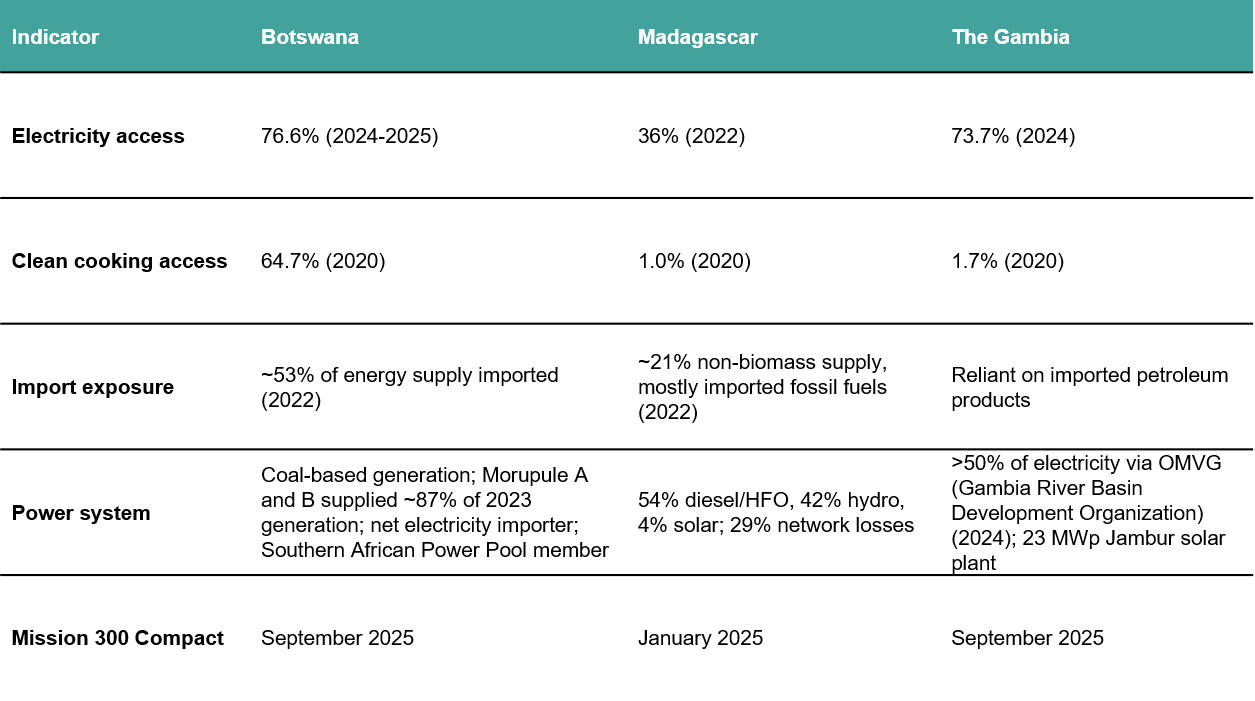
Source: National Energy Compacts for Botswana and The Gambia (September 2025) and Madagascar (January 2025); AFREC deep decarbonization pathway studies for Botswana, Madagascar and The Gambia (2025). Clean cooking access: World Bank, World Development Indicators (2020, latest common year).
A continental framework with national choices
AFREC, the African Union’s specialized energy agency, led development of ETSAP, supported by AfDB through the Africa Energy Transition Catalyst (AETC) Programme and the Sustainable Energy Fund for Africa (SEFA), alongside AFREC co-financing. ETSAP’s six pillars (universal access and energy security; energy efficiency; carbon-smart management of fossil resources; policy and regulatory harmonization; innovation and human capacity; and sustainable economic growth and prosperity) and seven sectoral workstreams (electricity, transport, buildings, industry, oil and gas, agriculture and clean cooking) provide a framework for a just transition through 2063, in three phases: 2025-2030, 2031-2040 and 2041-2063. Its value lies in translating continental ambition into national policy and investment decisions. Its continental actions for the first phase are costed at about EUR 12.3 million.[3]
Botswana, Madagascar and The Gambia were selected from 18 expressions of interest through a two-stage assessment. Criteria included regional and island representation, fossil-fuel and traditional-biomass dependence, existing transition support, institutional readiness, income, security and data availability. The energy mix, the absence of existing transition support and the enabling environment carried the greatest weight in the scoring. Their different starting points make the studies useful comparisons, although they cannot represent every African energy system.[4]
So far, the work has delivered a continental framework, three national pathways and a shared evidence base for policy discussion. For the first phase (2025-2030), the country studies set out near-term actions, mostly regulations, standards, supporting studies and institutional capacity, each with implementation milestones, institutional responsibilities and indicative budgets. Following technical validations held in 2025, the ETSAP was adopted by the Heads of State and Govenment in February 2026 and an African Union ministerial session in April 2026 called on AFREC and its partners to coordinate ETSAP implementation and its domestication at national level.[5] The final handover of NDDPs in all the three countries is expected to be concluded by November 2026.
Each national study was co-developed with national stakeholders through four waves of virtual and in-person consultations covering data validation, scenario framing, review of results and policy packaging. These brought together ministries, regulators, statistics offices, utilities, fuel distributors, the private sector and civil society. Beyond building ownership of the results, the process strengthened modeling literacy among civil servants, contributing directly to ETSAP’s human-capacity pillar.
Early uptake is visible mainly in the process. The draft results were reviewed in national consultative workshops held with the energy ministries: in Madagascar in March 2025, and in Botswana and The Gambia in April 2025. The next test of uptake will be formal government adoption of the pathways, and their use in Nationally Determined Contribution (NDC 3.0) submissions, integrated resource plans or Compact implementation. AFREC and AfDB will need to track these indicators, together with the number of officials trained, whether the Low Emissions Analysis Platform (LEAP) models are housed and updated within national ministries, and whether further member states request similar studies.[6]
The studies compare a baseline with two decarbonization scenarios, a deep decarbonization pathway (the DDP scenario) and a more ambitious long-term pathway (the Ambitious scenario), using LEAP. Their results are conditional scenarios, rather than forecasts or committed investments. They reveal which choices matter, what those choices might cost and where further appraisal is needed. Emission figures cited below refer to energy-related emissions and are not comprehensive estimates of emissions from non-renewable biomass or land use. Figure 1 summarizes the headline results.[7]
Figure 1: Annual energy-related emissions in 2063, baseline vs. more ambitious long-term pathways
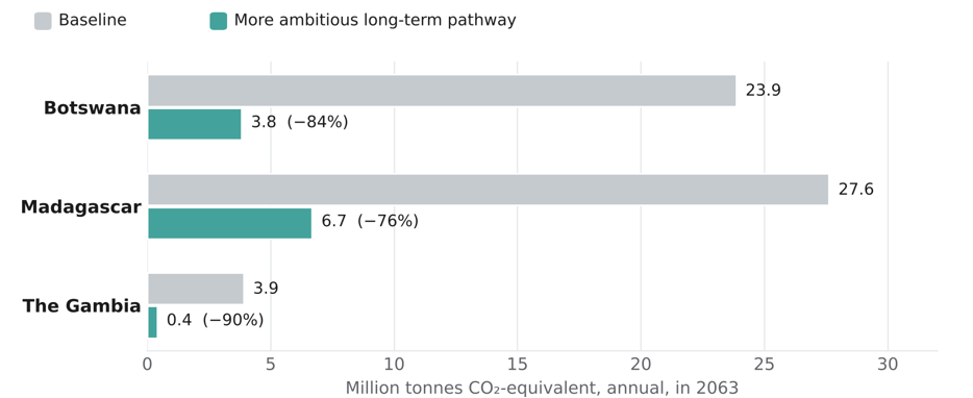
Source: AFREC deep decarbonization pathway studies for Botswana (June 2025), Madagascar (May 2025) and The Gambia (June 2025). Energy-related emissions only; modelled scenarios, not forecasts.
Botswana: renewable growth must withstand uncertainty over coal
Botswana’s transition is as much about resilience as about emissions, since imports supplied roughly 53% of the country’s energy in 2022, including petroleum and electricity. Domestic coal therefore does not remove exposure to external energy prices. Coal from the Morupule A and B plants supplied about 87% of electricity generated in 2023, renewables less than 3%, and imports still covered close to 45% of the electricity sent out and purchased in 2022. Expanding solar and wind can diversify supply, while electrifying transport can reduce oil dependence.[8]
The Ambitious scenario lowers annual energy-related emissions in 2063 from around 23.9 million tonnes of carbon dioxide equivalent in the baseline to 3.8 million tonnes, a reduction of approximately 84%. That is a substantial reduction, although residual emissions remain.[9]
Part of this result depends on carbon capture and storage after 2040, which remains a modelled option rather than an operating solution. Before relying on it, decision-makers would need evidence on storage suitability, infrastructure, capture performance and delivered costs. The country’s planned pathway also refers to green hydrogen, produced using renewable electricity, rather than blue hydrogen produced from fossil fuels with carbon capture. Its commercial viability requires more detailed analysis of electricity supply, water requirements and demand.[10]
This uncertainty strengthens the case for sequencing, in which solar, wind, efficiency and grid reinforcement proceed while more complex technologies are assessed. Coal investment decisions would benefit from testing against a scenario in which carbon capture arrives late or costs more than expected. Otherwise, an assumed future technology could justify investments that become expensive to operate or retire.
Regional trade adds both opportunity and risk, because the potential export surpluses identified in Botswana’s pathway are not the same as contracted sales. The country’s role in the Southern African Power Pool depends on transmission capacity, competitive delivered prices and solvent buyers. The report recommends strengthening the north-south transmission backbone, and identifying specific cross-border routes would require dedicated network and market studies before export-led generation is financed. Coal workers and affected communities also need retraining, income protection and credible local investment plans as the generation mix changes. In rural Botswana, where electricity access stands at about 25% and biomass still dominates cooking, dedicated mini-grid, off-grid and clean cooking programs are needed.[11]
Madagascar: access and efficiency belong at the center of decarbonization
Madagascar shows why energy transition analysis cannot begin and end with power generation, since biomass accounted for about 79% of energy supply in 2022, with imported fossil fuels accounting for most of the remainder. Hydropower and solar supply almost half of electricity but only a small share of total energy, because electricity is still a small part of the country’s energy use. Electricity generation was approximately 54% diesel and heavy fuel oil, 42% hydropower and 4% solar, while reported network losses reached 29%, reflecting aging and overloaded networks as well as commercial losses that weaken the utility’s finances. Expanding renewable generation without improving delivery would leave a large part of its potential benefit unrealized.[12]
Hydropower and solar provide the main renewable opportunities, with wind offering a complementary resource. Their development needs to be matched to demand centers, domestic transmission and distribution, storage where justified, and decentralized systems for communities that the main grid cannot reach economically. The National Energy Compact aims to raise access from 36% to 80% by 2030, about 3.5 million additional connections, with around 80% of new connections expected from solar home systems, nano-grids and mini-grids and the remainder from the national utility, JIRAMA; meeting these goals requires an estimated USD 7.2 billion of investment. As an island system, Madagascar has no mainland electricity interconnection in the pathway and its immediate integration challenge is domestic.[13]
Under the Ambitious scenario, annual energy-related emissions in 2063 fall from approximately 27.6 million tonnes of carbon dioxide equivalent in the baseline to 6.7 million tonnes, about 76% lower. The large baseline reflects growth in energy demand and continued fossil-fuel use across transport, productive sectors and electricity supply. Emissions from deforestation are not fully captured in this energy-sector estimate.[14]
Biomass accounting is particularly consequential because the Madagascar study treats biomass carbon dioxide as carbon-neutral in its inventory discussions, so a fuller accounting of emissions from non-renewable biomass would be a useful next step. Switching households to liquefied petroleum gas can therefore initially raise recorded fossil emissions even while reducing smoke exposure and pressure on wood resources. A sound investment assessment needs health, time savings and forest outcomes alongside the model’s emissions measure.[15]
Efficiency matters just as much, as the Ambitious scenario supplies greater electrified activity with roughly 43% less final energy in 2063 than the baseline. Efficient appliances, cooking technologies and electric transport can reduce fuel requirements without suppressing development. The practical challenge is affordability, since households need access to appliances, connections and reliable fuel or electricity supplies. Financing generation alone will not deliver these benefits.[16]
The Gambia: regional supply and domestic solar must work together
The Gambia’s transition starts from a different position, as electricity supplied through the Gambia River Basin Development Organization (OMVG) accounted for more than half of supply in 2024. The 23-megawatt-peak Jambur solar plant also entered the supply mix. In 2022, primary energy supply was about 60% traditional biomass and 40% imported petroleum products, while the national utility’s own generation contributed only about 11.6% of electricity in 2024 because of operational constraints.[17]
Energy accounts for about 24% of national greenhouse gas emissions, second to agriculture, forestry and other land use at 63%, and energy-related emissions are projected to rise sharply without mitigation. The Ambitious scenario reduces annual energy-related emissions in 2063 from approximately 3.9 million tonnes of carbon dioxide equivalent in the baseline to 0.4 million tonnes, around 90% lower. Domestic solar expansion, electrification and cleaner cooking underpin the transition. Reduced petroleum dependence could ease exposure to fuel-price shocks, while diversified electricity sources could improve resilience.[18]
Neither imports nor solar eliminates system risk, however, because imported electricity needs dependable suppliers, functioning interconnections and timely payments. Growing solar output needs operational flexibility and networks capable of delivering power when and where it is required. The appropriate balance should be tested under drought, supply interruptions and changing regional prices.
The Gambia study accounts for existing imports; a fully integrated optimization of regional dispatch, transmission investment and cross-border charges would be a valuable extension. Testing its national generation results against alternatives available through the West African Power Pool would add further value. The Gambia’s Energy Compact identifies a 225-kilovolt Soma-Basse eastern backbone, a network investment consistent with the pathway’s emphasis on regional supply.[19]
Equitable regional transmission cost allocation, examined in the companion article on the West African Power Pool, therefore becomes central to affordability. A low generation price will not necessarily translate into cheap delivered electricity if network charges are unpredictable or poorly aligned with benefits. Stronger regional regulation and transparent charging arrangements can make the transition pathway more credible to both importing utilities and investors.
Fuel savings are substantial, but they are not financing
The strongest common finding is that deeper decarbonization can reduce long-term system costs. Over 2040-2063, the window used in the studies’ cost comparison, the Ambitious scenarios report cumulative fuel-cost savings of approximately USD 39 billion in Botswana, USD 84 billion in Madagascar and USD 9.7 billion in The Gambia, relative to their respective baselines (Figure 2). These must be weighed against additional demand-side and energy-transformation costs of about USD 23.4 billion, USD 55 billion and USD 3.6 billion respectively. On average, the fuel-cost savings amount to roughly USD 1.6 billion, USD 3.5 billion and USD 0.4 billion a year. These values are large relative to today’s economies because they apply to energy systems that the studies project to grow substantially by 2063, so they indicate scale rather than precise forecasts.[20]
Figure 2: More ambitious long-term pathway: fuel cost savings vs. additional demand side and transformation costs, cumulative 2040-2063 (USD billion, constant 2022 dollars)
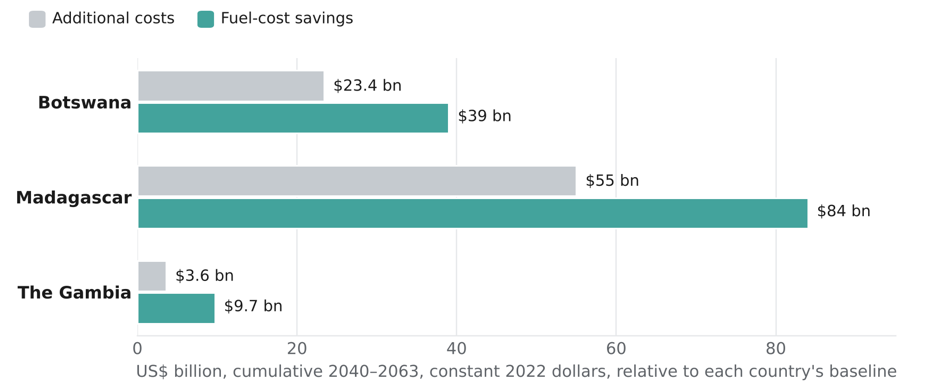
Source: AFREC deep decarbonization pathway studies for Botswana, Madagascar and The Gambia (2025). Cumulative 2040-2063 totals of annual model costs in constant 2022 dollars, as reported in the studies; not upfront investment requirements or secured finance.
These figures are cumulative totals of annual model costs in constant 2022 dollars, not upfront investment requirements, financing secured or guaranteed cash savings. A discounted comparison over the full 2025-2063 horizon, which would give early costs more weight than later savings, would strengthen the analysis. Differences in system size and assumptions also mean the results should not be used to rank national investment attractiveness.
In each case, moreover, the DDP scenario records larger net cost savings than the Ambitious scenario. The lowest-emission option is therefore not automatically the cheapest modelled option. In Madagascar, for example, the DDP scenario reduces system costs by about USD 45 billion (24%) relative to the baseline, while the Ambitious scenario delivers savings of around 15%. Net of the additional costs, the Ambitious scenario saves roughly USD 16 billion in Botswana, USD 29 billion in Madagascar and USD 6 billion in The Gambia over 2040-2063. Policymakers need to judge the additional costs against emissions reductions, resilience and other benefits, and test sensitivity to technology costs, fuel prices and financing conditions.[21]
Timing is a further constraint, because equipment, networks and connections must be financed before many fuel savings materialize. Madagascar’s Compact, for instance, puts the investment needed to meet its 2030 objectives at about USD 7.2 billion, which must be mobilized a decade or more before the fuel savings measured over 2040-2063 begin to accrue. Later economic benefits cannot by themselves meet today’s borrowing or affordability constraints.[22]
This is where development finance can make a difference: project preparation to establish viable investments; concessional capital for access and public benefits; guarantees where payment risks deter investors; and utility reforms that improve collections and service quality. Early support has already shown its value at the planning stage: modest technical-assistance funding under the AETC Programme helped deliver a continental framework and three national pathways. Financing the infrastructure they envisage is the next, and much larger, task.[23]
AfDB is already active along these lines in all three countries. Its Mission 300 technical assistance program, approved in January 2026 for 13 countries including Madagascar, places advisers in national Compact delivery and monitoring units. In Madagascar, the Bank also finances 220-kilovolt transmission between Antananarivo and Antsirabé under the PRIRTEM-II project. In The Gambia, SEFA has supported green mini-grids, and in Botswana it has funded technical assistance on least-cost planning and regulatory frameworks for private renewable energy. The pathways can now help AfDB and its partners decide which projects to prepare and finance next.[24]
Connecting long-term pathways to Mission 300 delivery
All three countries now have National Energy Compacts under Mission 300, the AfDB-World Bank initiative to connect 300 million people to electricity by 2030. Madagascar’s Compact was presented in January 2025, before its pathway study was completed in May 2025, and Botswana and The Gambia followed in September 2025. The pathways are therefore best seen as informing Compact implementation and future updates, rather than the Compacts themselves, and alignment should be demonstrated through decisions rather than assumed from shared objectives.[25]
The links to Mission 300 are clearest at country level. In Botswana, the pathway’s solar and wind expansion and north-south grid reinforcement match the Compact’s priorities for generation and regional integration through the Southern African Power Pool. In Madagascar, the emphasis on decentralized renewables and lower network losses fits a Compact in which off-grid solar and mini-grids are expected to deliver most new connections. In The Gambia, reliance on OMVG imports alongside domestic solar ties the pathway to the Compact’s regional transmission priorities, including the Soma-Basse backbone. Across all three, private participation and utility financial viability will determine whether the modelled investments are built and operated.[26]
National teams can use the pathways to test whether Compact investments remain sensible beyond 2030, and to inform Nationally Determined Contributions (NDCs), including the current round of updates (NDC 3.0), and long-term low-emission development strategies. The pathways are particularly useful here because they trace the technology mixes, financing envelopes and sectoral trade-offs that current NDCs do not set out in detail. This requires harmonized baselines, transparent biomass accounting and updated assumptions, rather than transferring model numbers directly into commitments.
Conclusion
With a continental framework and three national pathways in place, the next phase depends on implementation. The April 2026 AU ministerial session asked AFREC and its partners to coordinate ETSAP implementation and its domestication at national level, opening the way for pathway studies in further member states, while AfDB’s Mission 300 technical assistance offers a channel for linking the pathways to Compact delivery. For AfDB and its partners, the priority is to help countries convert the near-term actions identified in the pathways into bankable project pipelines, aligned with Compact delivery and tracked against the uptake indicators outlined above, so that progress can be compared across member states. The message for governments and financiers is that the cheapest long-term transition is not necessarily the deepest one, and that financing the early costs is what turns modelled fuel savings into real ones. Progress should be judged by measurable gains in access, reliability, clean cooking and fuel dependence.[27]
--
Sources:
[1] Deep Decarbonization Pathways for Botswana. Published June 2025. Accessed October 2026.
Voies de décarbonisation profonde pour Madagascar (Deep Decarbonization Pathways for Madagascar). Published May 2025. Unpublished document provided by AfDB.
Deep Decarbonization Pathways for The Gambia. Published June 2025. Unpublished document provided by AfDB.
[2] National Energy Compact for Botswana. Published September 2025. Accessed October 2026.
Voies de décarbonisation profonde pour Madagascar (Deep Decarbonization Pathways for Madagascar). Published May 2025. Unpublished document provided by AfDB.
National Energy Compact for the Republic of The Gambia. Published September 2025. Accessed October 2026.
Access to Clean Fuels and Technologies for Cooking (% of Population), World Development Indicators. Published 2025. Accessed November 2026.
[3] The African Energy Transition Strategy and Action Plan (ETSAP). Published September 2025. Accessed October 2026.
Africa Energy Transition Catalyst (AETC) Program – Phase I: Appraisal Report. Published May 2023. Unpublished document provided by AfDB.
Multinational – Africa Energy Transition Catalyst (AETC) Program Phase I – Project Summary Note. Published May 2023. Accessed October 2026.
[4] ETSAP–DDP Madagascar: Departmental Presentation. Published April 2026. Unpublished document provided by AfDB.
[5] The African Energy Transition Strategy and Action Plan (ETSAP). Published September 2025. Accessed October 2026.
AU Ministerial Session Backs Continental Frameworks on Transport and Energy. Published April 2026. Accessed October 2026. https://www.uneca.org/node/11622
[6] AFREC Hosts Consultative Workshop on National Deep Decarbonisation Pathways for Madagascar. Published March 2025. Accessed November 2026.
AFREC Hosts Consultative Workshop on National Deep Decarbonisation Pathways for Botswana as Part of Africa’s Energy Transition. Published April 2025. Accessed November 2026.
AFREC and AfDB Host Consultative Workshop on National Deep Decarbonisation Pathways for The Gambia. Published April 2025. Accessed November 2026.
[7] Deep Decarbonization Pathways for Botswana. Published June 2025. Accessed October 2026.
Voies de décarbonisation profonde pour Madagascar (Deep Decarbonization Pathways for Madagascar). Published May 2025. Unpublished document provided by AfDB.
Deep Decarbonization Pathways for The Gambia. Published June 2025. Unpublished document provided by AfDB.
[8] Deep Decarbonization Pathways for Botswana. Published June 2025. Accessed October 2026.
[9] Deep Decarbonization Pathways for Botswana. Published June 2025. Accessed October 2026.
[10] Deep Decarbonization Pathways for Botswana. Published June 2025. Accessed October 2026.
[11] Deep Decarbonization Pathways for Botswana. Published June 2025. Accessed October 2026.
[12] Voies de décarbonisation profonde pour Madagascar (Deep Decarbonization Pathways for Madagascar). Published May 2025. Unpublished document provided by AfDB.
[13] Voies de décarbonisation profonde pour Madagascar (Deep Decarbonization Pathways for Madagascar). Published May 2025. Unpublished document provided by AfDB.
[14] Voies de décarbonisation profonde pour Madagascar (Deep Decarbonization Pathways for Madagascar). Published May 2025. Unpublished document provided by AfDB.
[15] Voies de décarbonisation profonde pour Madagascar (Deep Decarbonization Pathways for Madagascar). Published May 2025. Unpublished document provided by AfDB.
[16] Voies de décarbonisation profonde pour Madagascar (Deep Decarbonization Pathways for Madagascar). Published May 2025. Unpublished document provided by AfDB.
[17] Deep Decarbonization Pathways for The Gambia. Published June 2025. Unpublished document provided by AfDB.
[18] Deep Decarbonization Pathways for The Gambia. Published June 2025. Unpublished document provided by AfDB.
[19] Deep Decarbonization Pathways for The Gambia. Published June 2025. Unpublished document provided by AfDB.
National Energy Compact for the Republic of The Gambia. Published September 2025. Accessed October 2026.
[20] Deep Decarbonization Pathways for Botswana. Published June 2025. Accessed October 2026.
Voies de décarbonisation profonde pour Madagascar (Deep Decarbonization Pathways for Madagascar). Published May 2025. Unpublished document provided by AfDB.
Deep Decarbonization Pathways for The Gambia. Published June 2025. Unpublished document provided by AfDB.
[21] Deep Decarbonization Pathways for Botswana. Published June 2025. Accessed October 2026.
Voies de décarbonisation profonde pour Madagascar (Deep Decarbonization Pathways for Madagascar). Published May 2025. Unpublished document provided by AfDB.
Deep Decarbonization Pathways for The Gambia. Published June 2025. Unpublished document provided by AfDB.
[22] Deep Decarbonization Pathways for The Gambia. Published June 2025. Unpublished document provided by AfDB.
Pacte énergétique national pour Madagascar (National Energy Compact for Madagascar). Published January 2025. Accessed November 2026.
Sommet de Dar es Salaam – Madagascar vise sept milliards de dollars d’investissement. Published January 2025. Accessed November 2026.
[23] Africa Energy Transition Catalyst (AETC) Program – Phase I: Appraisal Report. Published May 2023. Unpublished document provided by AfDB.
Multinational – Africa Energy Transition Catalyst (AETC) Program Phase I – Project Summary Note. Published May 2023. Accessed October 2026.
[24] AfDB Approves New Program to Help African Countries Turn Energy Promises into Power for Millions. Published January 2026. Accessed November 2026.
AfDB Approves US$43 Million Loan to Finance Madagascar’s Power Transmission Project. Published December 2020. Accessed November 2026.
The Gambia: SEFA Commits About $1 Million to Energy Access. Published February 2017. Accessed November 2026.
African Development Bank’s SEFA to Provide $1 Million in Support of Botswana’s Energy Transition. Published January 2022. Accessed November 2026.
[25] Mission 300: National Energy Compacts in Africa. Published October 2026. Accessed October 2026.
Pacte énergétique national pour Madagascar (National Energy Compact for Madagascar). Published January 2025. Accessed October 2026.
National Energy Compact for Botswana. Published September 2025. Accessed October 2026.
National Energy Compact for the Republic of The Gambia. Published September 2025. Accessed October 2026.
[26] National Energy Compact for Botswana. Published September 2025. Accessed November 2026.
Pacte énergétique national pour Madagascar (National Energy Compact for Madagascar). Published January 2025. Accessed November 2026.
National Energy Compact for the Republic of The Gambia. Published September 2025. Accessed November 2026.
[27] AU Ministerial Session Backs Continental Frameworks on Transport and Energy. Published April 2026. Accessed November 2026. https://www.uneca.org/node/11622
AfDB Approves New Program to Help African Countries Turn Energy Promises into Power for Millions. Published January 2026. Accessed November 2026.
Add New Comment