
Nigeria’s Electricity Decentralization: From Legal Reform to Market Outcomes
Introduction: A landmark law opens a new chapter for Nigeria’s power sector
Nigeria’s electricity decentralization is often described as a transfer of authority from Abuja to the States. The more consequential question is whether it changes who invests, how electricity is purchased and distributed, and how reliably customers are served. A constitutional amendment assented to on 17 March 2023 removed the restriction that had confined state electricity legislation to areas outside the national grid. The Electricity Act, signed on 9 June 2023, then replaced the Electric Power Sector Reform Act of 2005 reform law and established the legal architecture for a two-tier arrangement, with state markets alongside a nationally coordinated wholesale system. Therefore, decentralization is a statutory transition that must preserve the connections between state networks and the national system.
By August 2026, 17 Nigerian states had entered the formal transition to state electricity regulation, of which 16 had completed the regulatory handover. These included Enugu and Ekiti (22 October 2024), Ondo (23 October 2024), Imo (31 December 2024), Oyo (5 February 2025), Edo (20 February 2025), Kogi (12 March 2025), Lagos (4 June 2025), Ogun (23 June 2025), Niger (9 July 2025), Plateau (12 September 2025), Abia (24 December 2025), Anambra (1 January 2026), Nasarawa (3 February 2026), Bayelsa (20 February 2026), and Gombe (July 2026). Akwa Ibom joined the transition process on 18 August 2026, with completion scheduled for February 2027. This progression marks a significant step toward decentralizing Nigeria’s electricity sector, allowing states to develop regulatory frameworks tailored to their economic priorities and energy needs.
Nigeria's electricity access deficit illustrates both the scale of the challenge and the potential value of decentralization. According to Tracking SDG 7, only 63% of Nigeria's population had access to electricity in 2024, leaving approximately 86 million people without access. Moreover, supply constraints further compound this deficit: in 2023, average available generation was approximately 4.2 GW against 13 GW of installed capacity, meaning that less than one-third of nominal generation capacity was available. Also, distribution inefficiencies are equally significant, with only 44.4% of registered electricity customers metered at the end of 2023, leaving approximately 7.3 million customers without meters. These figures reveal that Nigeria's electricity challenge is not simply a shortage of installed generation capacity, but a combination of infrastructure bottlenecks, weak commercial performance, and uneven access. In this sense, decentralization offers an opportunity to address these constraints more directly by enabling states to identify local demand, develop tailored electrification strategies, facilitate distributed generation and mini-grids, and strengthen oversight of distribution companies, while state regulators may also be better positioned to enforce metering, service-quality standards, and consumer protection measures that reflect local conditions.
AfDB's response: AESTAP Nigeria
The African Development Bank’s support through the Africa Energy Sector Technical Assistance Programme (AESTAP) Nigeria was designed as a coordinated and programmatic intervention. Financed through the Sustainable Energy Fund for Africa (SEFA), the USD 995,000 grant, approved on 18 March 2024, supported a package of technical assistance initially scheduled to conclude in December 2025 and subsequently extended through June 2026. The intervention brought together the Federal Ministry of Power, the Nigerian Electricity Regulatory Commission (NERC), the Nigeria Governors’ Forum (NGF), and participating state governments to address the institutional and regulatory challenges of implementing the Electricity Act 2023.[1]
The programme was structured around four complementary institutional and development needs: establishing a coherent national electricity policy framework; developing procedures for the orderly transfer of regulatory responsibilities from NERC to state regulators; strengthening the capacity of states to establish and operate their own electricity markets; and supporting pilot states to identify, develop and prioritise viable, bankable energy projects through evidence-based State Electricity Priority Plans (SEPPs). These plans provide a basis for project preparation, investment mobilisation and engagement with development partners and private investors.. These components were designed to reinforce one another, combining national regulatory consistency with the flexibility needed to address state-specific electricity challenges, strengthening a coordinated implementation framework to support reforms undertaken. Notably, Nigerian institutions retained ownership of the reform, while other development partners, including UKNIAF/FCDO, the World Bank, GIZ and JICA, were engaged in complementary sector initiatives.
Beyond the immediate regulatory and planning outputs, AESTAP's contribution also reached a larger financing operation: its support to national policy dialogue and preparation of the National Integrated Electricity Policy helped Nigeria meet a prior action under Phase II of the AfDB's Economic Governance and Energy Transition Support Programme (EGET-SP). This link between technical assistance and policy-based financing is examined in the results section below.
Policy: from dialogue to a national policy
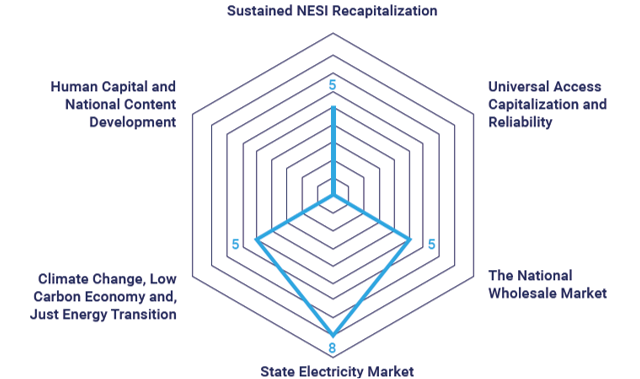
The eighth edition of the Africa Energy Market Place (AEMP), held in Abuja in May 2024, marked a shift from previous editions. Organized by the African Development Bank (AfDB) in partnership with Nigeria’s Federal Ministry of Power, with technical support from the Tony Blair Institute for Global Change (TBI) and collaboration from other development partners, the event focused for the first time entirely on policy dialogue. Bringing together government representatives, regulators, electricity companies, development partners and private sector stakeholders, the discussions aimed to inform the preparation of Nigeria’s National Integrated Electricity Policy (NIEP). Technical sessions held in April were followed by high-level discussions in May, resulting in 84 policy recommendations across six key areas. Of these, 23 were prioritized based on their potential impact and implementation timelines[2].
Building on this process, an AfDB-funded adviser supported the Ministry in preparing the NIEP, which was approved by the Federal Executive Council in May 2025, becoming Nigeria’s first integrated electricity sector policy since 2001[3]. These priorities raised during the AEMP discussions are closely reflected in the approved policy, with their corresponding areas of impact as displayed in the figure below.
Analysis of Top 23 priority policies
Source: African Development Bank. (2024). Country diagnostic note and policy priorities: Nigeria
The handover: rules for moving power from NERC to the states
To support the implementation of the Electricity Act 2023, the AfDB worked with NERC to develop a Transition Guideline and Implementation Roadmap, drawing on consultations and validation workshops involving more than 100 participants. The guidelines established a coordinated framework for the shift from federal to state electricity regulation, recognizing that states would move at different speeds. They outline two pathways: a status quo model, under which states that have not enacted their own electricity laws remain under NERC's oversight, and a full independence model, in which states establish their own regulatory frameworks for intrastate electricity markets, while NERC retains responsibility for interstate matters. Crucially, the transition involves much more than transferring regulatory authority. The guidelines set out the legal, commercial and technical steps needed to keep electricity services running as responsibilities change hands[4].
In this sense, the development of the Transition Guidelines and Implementation Roadmap helped inform NERC Regulatory Order No. NERC/2025/028, issued on 28 March 2025, concerning the delineation of assets and liabilities of electricity distribution licensees, providing greater regulatory clarity on how existing distribution assets and liabilities should be allocated as oversight shifts from NERC to state regulators, helping establish the conditions for an orderly transition to state electricity markets so it can access licensing and financing.[5]
Alongside the Transition Guidelines, the AfDB-supported technical assistance produced a Distribution Companies (DisCo) Asset Delineation Report, which identified six areas for potential amendments to strengthen the Electricity Act 2023. Recommendations were submitted to the Federal Ministry of Power for consideration, covering minimum national technical standards, regional electricity markets, the participation of NERC-licensed generation companies (GenCos) in state markets, the regulation of grid-connected independent electricity distribution networks (IEDN), federal–state dispute resolution, and the definition and obligations of host communities.
In this line, the Electricity Act (Amendment) Bill 2025, which still remains under legislative consideration, revisits several regulatory issues also identified through AfDB-supported technical assistance. While the Electricity Act 2023 already provided for technical standards and cooperation between federal and state regulators, the proposed amendments seek to clarify the allocation of regulatory responsibilities and strengthen institutional coordination. They also introduce provisions for Joint Electricity Regulatory Commissions (JERCs), allowing states to pool regulatory resources and exercise certain functions jointly
State readiness: a common legal and regulatory framework for the states
Through AESTAP, the AfDB supported the Nigeria Governors’ Forum (NGF) in developing a model State Electricity Law and ten complementary regulatory templates covering licensing, integrated resource planning, electricity distribution franchising, consumer protection and estimated billing, business continuity, performance reporting, corporate governance, public–private partnerships, shared-asset service agreements, and the operation of state regulators. Presented to state stakeholders at a validation workshop in July 2025, these harmonized instruments were designed to reduce the time and resources required to establish state electricity governance frameworks while promoting regulatory consistency across jurisdictions. Therefore, the templates provide a common regulatory foundation that states can adapt to their legislation, electricity demand profiles, and institutional capacities.
Pilot states and people
To help translate the Electricity Act 2023 from legislation into practical investment opportunities, the AfDB funded the development of State Electricity Priority Plans (SEPPs) for three pilot states: Ekiti, Enugu, and Oyo.
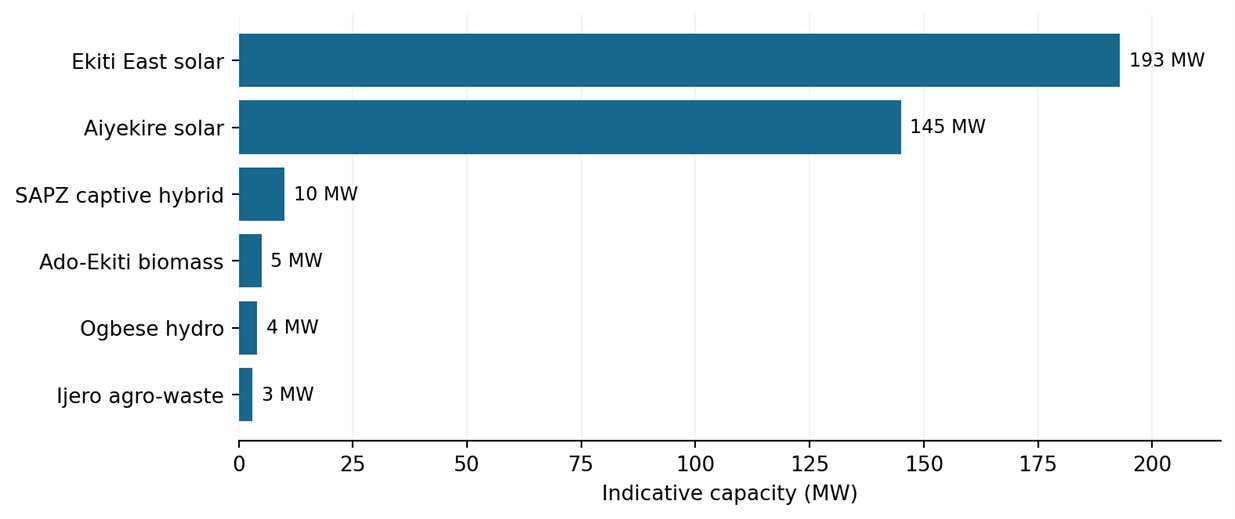
For Ekiti, the SEPP identifies a 548 MW supply gap, which will be partially addressed through ten renewable energy investment initiatives totaling approximately 368 MW, with indicative investment requirements of at least USD 352.8 million. The pipeline is dominated by two proposed solar developments: the 193 MW Ekiti East Solar Park, at feasibility stage, and the 145 MW Aiyekire Solar Farm. Other projects include small hydropower, biomass, captive generation, rural mini-grids and institutional solar installations. While most remain at early stages of development, this pipeline provides a starting point for project preparation, investor engagement and prioritization of future electricity investments.
Selected proposed Ekiti project capacities (MW)
Source: Ekiti State Electricity Priority Plan and Implementation Roadmap (2025)
Regarding Enugu, this case illustrates the distinction between establishing state regulatory autonomy and making it operational. Its 2023 Electricity Law and state regulator were already in place when AfDB-supported planning began, so the State Electricity Priority Plan, provided a practical foundation for investment and regulatory decision-making. In this sense, the plan analyzed billing and collection performance, electricity losses and metering coverage, classified customer clusters, developed on-grid and off-grid electrification strategies, investment and financing options, and a capacity-building roadmap for EERC based on an assessment of staff competencies. Under its most-likely scenario, peak demand among grid-connected customers is projected to rise from approximately 288 MW in 2024 to 802 MW by 2044, with a total generation required of 3,142 GWh by 2044.
In addition, the challenges of exercising state autonomy became apparent in a separate tariff dispute in July 2025, when EERC reduced the Band A electricity tariff from ₦209.50 to ₦160.40 per kWh, effective August 1. NERC questioned the treatment of federal generation subsidies and wholesale electricity costs, while EERC defended its authority to set intrastate tariffs. The disagreement exposed a central challenge of decentralization: balancing state regulatory independence and consumer affordability with cost recovery across an interconnected national electricity system.
Lastly, Oyo's SEPP provided a detailed assessment of consumer clusters, electricity supply constraints, and distribution infrastructure. It evaluated 31 distribution feeders, identifying reliability gaps, overloaded infrastructure, and a substantial metering deficit, with approximately 55–60% of consumers lacking meters. The plan also identified an indicative portfolio of six investment projects, predominantly at preliminary development stages, with estimated capital requirements of approximately USD 81–86 million. These investments include a proposed statewide smart-metering program, alongside solar mini-grids, hydropower, biogas, and distribution upgrades, with a combined proposed generation capacity of up to 8.54 MW.
Beyond policy reform and investment planning, AESTAP supported the development of the technical and institutional capacity needed to operationalize decentralized electricity markets. In partnership with the Africa School of Regulation (ASR), the programme delivered an 11-week hybrid training course, comprising ten weeks of virtual instruction and a one-week in-person session in Accra, Ghana. Two cohorts of ten officials completed the training in June 2024 and June 2025, respectively.[6] All 20 participants received certification, with women accounting for 30% of trainees. Drawn from national and state electricity institutions, participants received specialized training in regulatory economics, electricity market design, licensing, tariff regulation, and implementation of the Electricity Act 2023.[7] The initiative helped establish a pool of certified professionals equipped to support the development, regulation, and oversight of emerging state electricity markets.
What decentralization still has to resolve
Decentralization gives states greater scope to tailor electricity regulation to local needs, but it also creates risks of regulatory fragmentation. Across Nigeria's 36 states, divergent licensing requirements, tariff methodologies and reporting standards could raise transaction costs for investors operating in several jurisdictions. AESTAP's model State Electricity Law and regulatory templates offer a basis for consistency, but their benefits will depend on adoption and implementation. The Nigeria Governors' Forum (NGF) and the Forum of Nigerian Electricity Regulators (FoNER), inaugurated in March 2026, can help support coordination and knowledge sharing among state regulators.
Tariff setting is a particularly immediate test. As the Enugu dispute illustrates, state autonomy does not eliminate the cost of power purchased and transmitted through the national system. Where tariffs fall below recoverable costs, transparent and adequately funded subsidies are needed to avoid worsening financial pressure on distribution companies. AfDB's further support for State Electricity Tariff Setting Guidelines, including adaptation in five pilot states (Enugu, Ekiti, Oyo, Niger and Plateau), is intended to address this challenge, although consistent application will remain essential.
Coordination with the national electricity market poses a related risk. Electricity networks and financial obligations cross state boundaries, making asset and liability delineation, boundary metering, shared-infrastructure agreements and clear operating responsibilities indispensable. Without compatible data, workable dispute-resolution arrangements and cooperation among NERC, state regulators, transmission operators and suppliers, the transition could generate regulatory and commercial uncertainty.
Investment readiness remains another constraint. The SEPPs identify sizeable opportunities, but many proposed projects are still at preliminary stages and depend on creditworthy offtakers, enforceable contracts, reliable revenue collection and predictable regulation. NERC's second-quarter 2026 figures—81% collection efficiency and average aggregate technical, commercial and collection losses of 36% across distribution companies—underline the commercial risks that prospective investors must assess.
Finally, capacity will vary across states. AESTAP's training of 20 regulatory officials provided an initial pool of qualified professionals, but effective oversight also depends on sustained staffing, funding, tariff-review expertise, service-quality monitoring and enforcement capacity. NERC must meanwhile continue overseeing federal and interstate matters, as well as states that have not completed the transition. These institutional differences will shape the pace and quality of implementation.
Big impact and the road ahead
A particularly important result is the connection between AESTAP's upstream technical assistance and the African Development Bank's two-phase Economic Governance and Energy Transition Support Programme (EGET-SP; SAP code P-NG-K00-012). Phase I, a USD 500 million AfDB loan fully disbursed on 18 September 2024, included the establishment of an inter-ministerial energy committee, helping lay the groundwork for subsequent reforms. The National Integrated Electricity Policy (NIEP), approved by the Federal Executive Council in May 2025, was a prior action under Phase II. By supporting national policy dialogue and preparation of the NIEP, AESTAP contributed directly to Nigeria's fulfilment of this prior action. This is a concrete example of how upstream technical assistance can help deliver reforms required under a larger financing operation.
The next link in the results chain is from regulatory readiness to investment identification. AESTAP-supported State Electricity Priority Plans (SEPPs) for Ekiti, Enugu and Oyo combine demand assessments, consumer clustering, network constraints, renewable-energy opportunities and investment prioritization. Their contribution is to turn broad electricity-access ambitions into geographically identified interventions and possible delivery models, while identifying the commercial assumptions that future project preparation must test. Ekiti offers a promising illustration: its SEPP assessments and project pipeline have informed the identification and prioritization of potential state-level electrification investments linked to the Desert to Power / Nigeria Electrification Project Phase II pathway. This is an investment-development opportunity, not yet evidence that the proposed projects have been financed or built.
These results also connect with Mission 300, which seeks to connect 300 million additional Africans to electricity by 2030 and uses National Energy Compacts to link country-owned reforms to investment, financing and measurable outcomes. The 2024 Africa Energy Market Place, convened by AfDB and Nigeria's Federal Ministry of Power, generated 84 recommendations spanning state electricity markets, sector recapitalization, access and reliability. AESTAP's support to the NIEP, state regulatory frameworks and SEPPs complements this policy-to-delivery approach: it creates enabling rules and identifies potential investments, while leaving the difficult task of converting plans and finance into electricity connections and better service performance still ahead.
Conclusion
Nigeria's next challenge is to turn its new policy and regulatory foundations into financed projects and better electricity services. Three priorities follow from AESTAP's experience: extending targeted assistance to states still building regulatory institutions; advancing the SEPP pipelines through feasibility studies, project preparation, transaction support and financing mobilization; and strengthening practical market instruments, particularly tariff methodologies, market rules and consumer protections. These steps will require sustained cooperation between federal and state regulators, alongside attention to commercial viability and affordability.
Beyond Nigeria, the experience offers a lesson for other countries considering greater decentralization: transferring legal powers is only the beginning. Harmonized regulatory tools, credible state investment plans and trained institutions can help make reform operational, but their ultimate value depends on implementation. Nigeria's progress should therefore be measured not only by the number of states that complete regulatory handovers, but by the investments mobilized, connections delivered and improvements in electricity reliability and affordability for households and businesses.
---
[1] African Development Bank. (2025, November). Africa Energy Sector Technical Assistance Programme (AESTAP)—Nigeria support: Programme report [Internal presentation]; African Development Bank. (2026, June 30). Simplified project completion report: AESTAP Nigeria support [Internal report].
[2] African Development Bank. (2024). Africa Energy Market Place (AEMP) 2024: Final report [Programme report].
[3] African Development Bank. (2025, November). Africa Energy Sector Technical Assistance Programme (AESTAP)—Nigeria support: Programme report [Internal presentation]; African Development Bank. (2026, June 30). Simplified project completion report: AESTAP Nigeria support [Internal report].
[4] Nigerian Electricity Regulatory Commission & PwC. (2024, December). Electricity Act 2023: Implementation plan and transition guideline
[5] African Development Bank. (2026, June 30). Simplified project completion report: AESTAP Nigeria support [Internal report].
[6] African Development Bank. (2025, November). Africa Energy Sector Technical Assistance Programme (AESTAP) – Nigeria Support: Programme report [Presentation]
[7] African Development Bank. (2026, June 30). Africa Energy Sector Technical Assistance Program (AESTAP) – Nigeria Support: Simplified project completion report
Add New Comment