
How Regulatory Harmonization Can Strengthen Electricity Trade in COMESA
Introduction
Building a transmission line between two countries does not, on its own, create a dependable electricity market, because a generator still needs permission to sell across the border, get access to the network and confidence that its buyer will pay. An importing utility needs to recover the cost of that electricity while supplying customers affordably. When these conditions are uncertain, physical connections can deliver less value than their capacity suggests.
The Ethiopia-Kenya interconnector shows both what regulation has already made possible and what it still has to unlock. The 500 kV direct-current line, financed largely by the World Bank and AfDB, can carry 2,000 MW, yet Kenya has imported just about 200 MW of mainly hydropower since November 2022, and a supply agreement signed in July 2026 is set to raise this to 400 MW from December 2026. According to the Regional Association of Energy Regulators for Eastern and Southern Africa (RAERESA), these volumes reflect what Kenya planned to import under its power development plans rather than any limit of the line, so low use is not itself a sign of regulatory failure. The final tariff was reviewed by the regulators of both countries against agreed regulatory principles, including those of the Common Market for Eastern and Southern Africa (COMESA), which RAERESA sees as one reason the project has become a reference case for regional trade.[1] The larger opportunity is the line’s remaining capacity, about 1,600 MW once imports reach 400 MW, which RAERESA sees as able to serve Rwanda, Burundi and Tanzania in future. Reaching those markets would mean moving power across other countries’ networks and selling it to utilities in other jurisdictions. That depends on compatible access rules, predictable wheeling charges and buyers able to pay, which are the conditions that regional regulatory harmonization is meant to create.
National regulation and utility performance therefore belong at the center of regional electricity integration, since clear access rules make transactions possible and financially sound utilities make them sustainable. Well-functioning power pools, with clear and transparent trading rules, then turn these national foundations into regional trade and give private developers of merchant power projects a market to sell into. COMESA has developed common regulatory principles, performance indicators and tariff-assessment tools that can help countries address both sides of that equation. Its initial assessments identify where implementation should begin: regulatory authority, losses, cost transparency and reliable reporting.[2]
The completed frameworks and the functioning data platform are valuable achievements, but they do not yet show that the initiative has increased electricity trade, reduced tariffs or attracted additional investment. Those outcomes will depend on whether governments and regulators use the findings to change national practice. This is where coordinated domestication of developed frameworks by countries is critical. Early signs of movement are nonetheless visible in 2026: all 13 countries are on board for the second reporting cycle of the information system, several regulators are applying the regional principles in tariff reviews, and Rwanda, Kenya and Uganda have begun aligning cost studies, tariff reviews or grid codes with them. RAERESA has also submitted a proposal to AfDB for a second phase to support national implementation.[3]
Common principles must become workable national rules
The African Development Bank (AfDB) supported the first phase through a grant of 1.1 million Units of Account, reported as approximately USD 1.5 million, under the African Development Fund’s fifteenth replenishment Regional Public Goods window. This financed technical assistance for regulatory and utility benchmarking, tariff analysis and an Information Management System (IMS), rather than electricity infrastructure. RAERESA implemented the work with support from the Energy Regulators Association of East Africa (EREA).[4]
The 13-country assessment covered 12 COMESA members, namely Burundi, Djibouti, Egypt, Eritrea, Ethiopia, Kenya, Libya, Rwanda, Somalia, Sudan, Tunisia and Uganda, together with South Sudan, which is not a COMESA member but was included through EREA, the joint implementer, as a member of the East African Community. Countries belonging to both COMESA and the Southern African Development Community (SADC), such as Malawi, Zambia and Zimbabwe, were left to a parallel initiative led by the Regional Electricity Regulators Association of Southern Africa (RERA), so that the same regulators would not be assessed twice. Within the sample, RAERESA sought a mix of countries with and without a regulator, and of mature and nascent regulators.[5][6]
Coordination matters because many COMESA members also belong to SADC and trade through the Eastern Africa Power Pool (EAPP) or Southern African Power Pool (SAPP). None of the 13 assessed countries belongs to the Southern African Power Pool, so RERA’s work is the main route by which the same principles reach COMESA’s southern members. According to RAERESA, a similar framework is being applied in Southern Africa, and Zambia and Zimbabwe have already used the COMESA tools in part, although Zambia, which lies between the two power pools, faces additional alignment questions. To avoid a parallel rulebook, national reforms also need to be checked against the relevant power pool’s trading and operating requirements.[7]
The practical objective is to make national rules compatible without requiring identical electricity systems, so countries can retain different ownership structures and tariff levels while providing consistent principles for licensing, network access, transparent decisions and dispute resolution. Accounting separation between generation, transmission and distribution can make costs visible even where the utility remains vertically integrated. This helps regulators assess whether access conditions favor an incumbent and whether network charges reflect the service provided.[8]
The baseline identifies constraints that affect trade
The 2024 assessments offer three particularly useful findings (figure below). First, seven of the 13 countries had operational regulatory bodies, while six lacked one or had not fully operationalized it. Institutional existence was only part of the issue: the tariff assessment identified regulator-approved tariffs in four countries, Egypt, Kenya, Rwanda and Uganda, while approval in the other nine rested with government or parliament.[9]
Headline results from the 13-country baseline and Phase I completion reporting
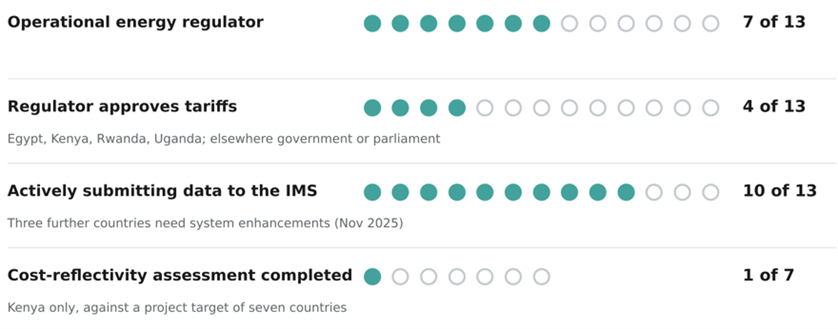
Source: COMESA maiden reports on regulatory and utility KPIs and on tariffs (September 2024); Simplified Project Completion Report (November 2025).
Creating a regulator does not, by itself, make tariff decisions predictable, since investors and power suppliers need a clear methodology, a review timetable and an enforceable route to recover efficiently incurred costs. Governments also need a transparent way to fund social objectives. Otherwise, a utility can sign an import contract without assurance that its revenue will cover the resulting obligations.
Second, all 13 countries reported a distribution-loss figure, ranging from 16.5% in Tunisia to 23.0% in Eritrea, although several are round numbers that may be estimates. These observations cover different years, mainly 2021-2023, and different operating circumstances. Uganda’s figure, for example, relates to the distribution concessionaire Umeme. They should therefore not be read as a current ranking, although they show why reducing losses deserves attention alongside new supply.[10]
To be useful, loss indicators need to distinguish between different problems, yet the maiden utility report combines technical and commercial losses in its distribution-loss measure. The cost-of-service model separates them, while the tariff framework identifies collection efficiency and debtor days as relevant drivers. Regulators should bring these measures together: overloaded networks require different remedies from inaccurate meters, unbilled consumption or unpaid bills. A single loss percentage cannot tell them which intervention will work.[11]
Third, data coverage was uneven, with Egypt, Kenya, Rwanda and Uganda reporting more utility indicators than several peers, and the reports consequently propose phased reporting, beginning with more feasible measures before adding demanding indicators. That is a sensible implementation choice if missing information triggers a capacity-building response. It becomes a weakness if incomplete data is mistaken for good performance or if countries are compared without checking definitions.[12]
Cost recovery requires better evidence and explicit protection
Headline electricity prices are a poor guide to regulatory quality because they reflect generation resources, network costs, subsidies, customer mix and service quality. A low tariff may indicate inexpensive supply, but it may also conceal a revenue shortfall paid for through government transfers, supplier arrears or deferred maintenance. A higher tariff may finance reliable service or pass avoidable inefficiency to consumers. The policy question is which costs are justified and who should pay them.[13]
COMESA’s Cost Reflectivity Assessment Framework Tool addresses that question by allocating a utility’s revenue requirement across customer categories. The accompanying model distinguishes energy, demand and customer-related costs, alongside voltage levels, assets and losses, and then compares allocated costs with tariff revenue. These steps make cross-subsidies visible and allow a regulator to examine the consequences of alternative tariff structures.[14]
The first application of the tool also exposed the limits of available information, as Kenya was the only country with sufficient data for the reported assessment, against a project completion target of seven countries in total, a gap that RAERESA attributes to differences in sector maturity: Kenya has unbundled its power sector and ranks among the leading countries on AfDB’s Electricity Regulatory Index.[15] Using Kenya Power’s accounts for the year to June 2023, the initial exercise found that tariffs recovered only about 36% of the cost allocated to domestic customers and 22% for street lighting, while small commercial customers paid 283% and commercial and industrial customers 475% of their allocated costs. Its results require careful validation of customer classifications and cost-allocation assumptions before being used for tariff decisions.[16]
This finding matters for project design, because tools and training alone do not remove the need for audited accounts, asset registers, customer data and load information. Support for those foundations may produce more useful regulatory decisions than expanding the number of indicators before countries can populate them reliably. The design lesson for the proposed second phase is to sequence support: a data-readiness assessment and help with accounts, asset registers and customer databases first, then roll-out of the cost-of-service model country by country. RAERESA’s Phase II proposal reflects this lesson by including support for utilities to keep system accounts that report technical and commercial losses and the other data regulators need, alongside technical training and help in drafting new rules.[17]
Cost recovery should also be paired with efficiency and affordability, and regulators can set achievable loss-reduction targets, scrutinize procurement and operating costs, and phase tariff changes against service improvements. Governments can then identify the consumers requiring support, the size of that support and a dependable funding source. Unfunded subsidies undermine the utility while abrupt tariff increases can undermine public support for reform. Making these choices transparent helps manage both risks.
These choices have direct regional consequences, since an importing utility with credible revenues is better placed to pay suppliers, maintain its network and enter longer-term contracts. Conversely, subsidizing domestic supply through accumulating arrears can transmit payment risk across borders. Tariff reform and regional trade therefore need to be planned together, including how imported power costs enter national tariff reviews.
The information system should change regulatory decisions
The IMS was launched in Lusaka on 21 March 2025. Ten countries were fully connected and submitting data by November 2025, with three requiring system enhancements. By November 2026, following a meeting with national liaison officers, all 13 countries were on board for the second reporting cycle and several had already submitted current-year data, although some had faced difficulties along the way.[18][19]
RAERESA has started to track whether regulators use this information through its first energy market monitoring report, prepared in 2026 from IMS data. The report found close to ten countries in the region directly applying the regional principles when reviewing tariffs and monitoring utility key performance indicators, with regulators using the indicators to follow up with utilities on what they should deliver and report. Kenya and Uganda are applying the tools in current tariff work.[20]
Used consistently, the reporting lets a regulator test a tariff request against purchases, losses, billing and collections, approve specific measures and track results at the next review. Comparable definitions allow peers to challenge unusual figures and identify useful practices. Used in this way, a regional database can improve national decisions and, ultimately, the reliability of counterparties in cross-border trade, although the next reporting cycles will show whether this intended use takes hold.
For that cycle to work, regulators need enforceable reporting obligations and named officers responsible for validating submissions. Utilities will need systems that reconcile operational and financial data, and RAERESA will need dependable hosting, technical support and recurring peer review. These operating arrangements are part of the reform rather than administrative details.
Implementation should be judged by market and service outcomes
Political backing for the reform is in place: COMESA’s 45th Council of Ministers adopted the first-phase instruments for national implementation on 28 November 2024. Infrastructure ministers subsequently directed resource mobilization on 27 June 2025. At the 24th COMESA Summit in Nairobi on 9 October 2025, Heads of State acknowledged AfDB’s support and directed RAERESA to mobilize resources for implementation. Domestication into national law remains the task of each member state.[21] This directive was reiterated at the 25th Heads of State Summit held on 22 October 2026 in Harare, Zimbabwe. According to RAERESA, it is the first time Heads of State have issued the same directive twice, calling on AfDB to go beyond frameworks and support member states in moving the instruments to national results.[22]
Responding to these directives, RAERESA has submitted a proposal to AfDB for grant funding of a second phase, which remains under consideration. The proposed phase would bridge the adopted frameworks and national decisions by aligning national rules with the trading requirements of the Eastern Africa and Southern African power pools, helping regulators adopt tariff methodologies, open-access regulations and wheeling rules, some of which will require changes to national law, and supporting utilities to keep accounts that report technical and commercial losses. Predictable wheeling charges matter for cross-border trade, and the companion article on Regional Transmission Cost Allocation in the West African Power Pool examines the allocation choices in greater detail.[23]
National implementation should start with a published gap assessment against the regional principles. Ministries should identify necessary legislative changes and clarify institutional mandates. Regulators should adopt tariff methodologies, access procedures and reporting obligations through consultation. Utilities and system operators should implement accounting separation, data controls and operational procedures. Joint national teams can coordinate these tasks, but each action needs a responsible institution, a deadline and a budget.
The clearest link to Mission 300, the AfDB-World Bank initiative to connect 300 million people to electricity by 2030, is its regional integration pillar, where COMESA’s principles on transparent network access, market rules and wheeling apply directly. Among the countries assessed, Burundi, Ethiopia, Kenya, Rwanda and Uganda have National Energy Compacts, several of which contain commitments that the COMESA indicators could track. Kenya commits to operationalizing regional market rules and open access and to cutting system losses from 23% to 15% by 2030, while Ethiopia targets a reduction in distribution losses from 22% to 13% and full cost recovery by 2028. RAERESA sees loss reduction as the most direct link, because high losses keep end-user prices high even when supply is available, and comparable tariff and performance data would let regional peers check progress against these commitments.[24] Figure below shows how far each Phase I instrument has moved towards national results.
Progress of Phase I instruments along the results chain, as of November 2026
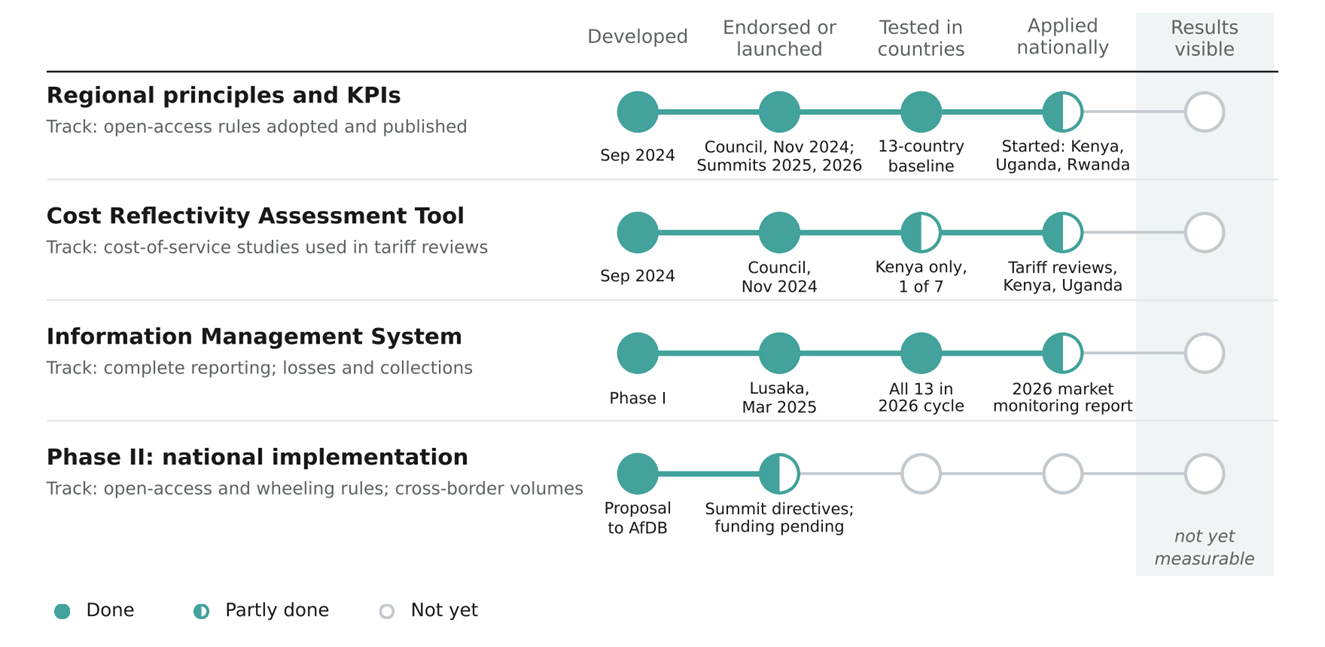
Source: COMESA maiden reports (September 2024); COMESA Council of Ministers and Summit records (2024-2026); interview with Dr. Geoffrey Aori Mabea, RAERESA (November 2026). Stages reflect the author’s framing.
Conclusion
COMESA has completed the first phase of a regional regulatory agenda that, if applied nationally, would make cross-border electricity trade easier to contract, finance and pay for. Progress should now be measured through operational open-access rules, published wheeling tariffs, timely and complete reporting, lower technical and commercial losses, better collections and fewer payment arrears. Ultimately, countries should track actual cross-border electricity volumes and service reliability, while recognizing that new infrastructure, weather and supply conditions also influence results. COMESA’s common tools provide a basis for that discipline, and their value will be realized when consistent evidence produces enforceable decisions and more dependable electricity services.
What happens next depends largely on AfDB’s decision on the proposed second phase. COMESA Heads of State have now twice called for support so that member states can complete the domestication on which the harmonization agenda depends, and RERA’s parallel work extends the same principles to SADC members. In the words of Dr. Geoffrey Aori Mabea, Chief Executive Officer of RAERESA, the Bank’s participation in Phase II would be a major decision in moving from frameworks to implementation, turning paper-based proposals into results visible within two years. He said the goal is to see effective regulators, liquid utilities and an integrated power market within COMESA, ultimately supporting the operationalization of the African Single Electricity Market.”[25]
---
[1] Interview with Dr. Geoffrey Aori Mabea, Chief Executive Officer, Regional Association of Energy Regulators for Eastern and Southern Africa (RAERESA). Conducted 10 November 2026.
Kenya Deepens Ethiopian Power Imports in Fresh Supply Deal. Published July 2026. Accessed November 2026. https://www.breakingkenyanews.com/2026/07/14/kenya-deepens-ethiopian-power-imports-in-fresh-supply-deal/
Kenya to Double Electricity Imports From Ethiopia to 400MW in December. Published September 2026. Accessed November 2026. https://www.kenyans.co.ke/news/127132-kenya-double-electricity-imports-ethiopia-400mw-december
[2] Maiden Report on Regional Electricity Regulatory Principles and Regulatory Key Performance Indicators. Published September 2024. Accessed October 2026. https://www.comesa.int/wp-content/uploads/2025/03/b.-Maiden-Report_RERP-and-RKPI_.pdf
Maiden Report on Utility Key Performance Indicators for COMESA. Published September 2024. Accessed October 2026. https://www.comesa.int/wp-content/uploads/2025/03/c.-Maiden-Report_UKPI_14.10.24_vF.pdf
Maiden Report on Harmonized Comparison of Electricity Tariffs and Cost Reflectivity Assessment in the COMESA Region (French edition). Published September 2024. Accessed October 2026. https://www.comesa.int/wp-content/uploads/2025/03/f.-Maiden-Report_HCET-and-Cost-Reflectivity_08.10.24__FR.pdf
[3] Interview with Dr. Geoffrey Aori Mabea, Chief Executive Officer, Regional Association of Energy Regulators for Eastern and Southern Africa (RAERESA). Conducted 10 November 2026.
[4] Simplified Project Completion Report: Regional Harmonization of Regulatory Frameworks and Tools for Improved Electricity Regulation in COMESA. Published November 2025. Unpublished document provided by AfDB.
Opening Remarks at the RAERESA Information Management System Launch. Published March 2025. Unpublished document provided by AfDB.
COMESA Heads of State Laud AfDB for Advancing Regional Energy Regulation Harmonization. Published November 2025. Accessed October 2026. https://africa-energy-portal.org/news/comesa-heads-state-laud-afdb-advancing-regional-energy-regulation-harmonization
[5] Framework Report on Regional Electricity Regulatory Principles and Regulatory and Utility Key Performance Indicators for COMESA. Published September 2024. Accessed October 2026. https://www.comesa.int/wp-content/uploads/2025/03/a.-Final-Framework-Report_08.09.24.pdf
[6] Interview with Dr. Geoffrey Aori Mabea, Chief Executive Officer, Regional Association of Energy Regulators for Eastern and Southern Africa (RAERESA). Conducted 10 November 2026.
[7] Interview with Dr. Geoffrey Aori Mabea, Chief Executive Officer, Regional Association of Energy Regulators for Eastern and Southern Africa (RAERESA). Conducted 10 November 2026.
[8] Maiden Report on Regional Electricity Regulatory Principles and Regulatory Key Performance Indicators. Published September 2024. Accessed October 2026. https://www.comesa.int/wp-content/uploads/2025/03/b.-Maiden-Report_RERP-and-RKPI_.pdf
[9] Maiden Report on Regional Electricity Regulatory Principles and Regulatory Key Performance Indicators. Published September 2024. Accessed October 2026. https://www.comesa.int/wp-content/uploads/2025/03/b.-Maiden-Report_RERP-and-RKPI_.pdf
Maiden Report on Harmonized Comparison of Electricity Tariffs and Cost Reflectivity Assessment in the COMESA Region (French edition). Published September 2024. Accessed October 2026. https://www.comesa.int/wp-content/uploads/2025/03/f.-Maiden-Report_HCET-and-Cost-Reflectivity_08.10.24__FR.pdf
[10] Maiden Report on Utility Key Performance Indicators for COMESA. Published September 2024. Accessed October 2026. https://www.comesa.int/wp-content/uploads/2025/03/c.-Maiden-Report_UKPI_14.10.24_vF.pdf
[11] Maiden Report on Utility Key Performance Indicators for COMESA. Published September 2024. Accessed October 2026. https://www.comesa.int/wp-content/uploads/2025/03/c.-Maiden-Report_UKPI_14.10.24_vF.pdf
Framework Report on Harmonized Comparison of Electricity Tariffs and Cost Reflectivity Assessment in the COMESA Region. Published September 2024. Accessed October 2026. https://www.comesa.int/wp-content/uploads/2025/03/d.-Framework_HCET-Cost-Reflectivity_26.09.24.pdf
Training Manual on Cost Reflectivity Assessment. Published September 2024. Unpublished document provided by AfDB.
Cost-of-Service Model (Appendix 1 to the Training Manual on Cost Reflectivity Assessment). Published September 2024. Unpublished document provided by AfDB.
[12] Maiden Report on Utility Key Performance Indicators for COMESA. Published September 2024. Accessed October 2026. https://www.comesa.int/wp-content/uploads/2025/03/c.-Maiden-Report_UKPI_14.10.24_vF.pdf
[13] Framework Report on Harmonized Comparison of Electricity Tariffs and Cost Reflectivity Assessment in the COMESA Region. Published September 2024. Accessed October 2026. https://www.comesa.int/wp-content/uploads/2025/03/d.-Framework_HCET-Cost-Reflectivity_26.09.24.pdf
Maiden Report on Harmonized Comparison of Electricity Tariffs and Cost Reflectivity Assessment in the COMESA Region (French edition). Published September 2024. Accessed October 2026. https://www.comesa.int/wp-content/uploads/2025/03/f.-Maiden-Report_HCET-and-Cost-Reflectivity_08.10.24__FR.pdf
[14] Training Manual on Cost Reflectivity Assessment. Published September 2024. Unpublished document provided by AfDB.
Cost-of-Service Model (Appendix 1 to the Training Manual on Cost Reflectivity Assessment). Published September 2024. Unpublished document provided by AfDB.
[15] Interview with Dr. Geoffrey Aori Mabea, Chief Executive Officer, Regional Association of Energy Regulators for Eastern and Southern Africa (RAERESA). Conducted 10 November 2026.
[16] Simplified Project Completion Report: Regional Harmonization of Regulatory Frameworks and Tools for Improved Electricity Regulation in COMESA. Published November 2025. Unpublished document provided by AfDB.
Maiden Report on Harmonized Comparison of Electricity Tariffs and Cost Reflectivity Assessment in the COMESA Region (French edition). Published September 2024. Accessed October 2026. https://www.comesa.int/wp-content/uploads/2025/03/f.-Maiden-Report_HCET-and-Cost-Reflectivity_08.10.24__FR.pdf
[17] Interview with Dr. Geoffrey Aori Mabea, Chief Executive Officer, Regional Association of Energy Regulators for Eastern and Southern Africa (RAERESA). Conducted 10 November 2026.
[18] Back to Office Report: RAERESA Information Management System Launch and Peer Review Mission. Published April 2025. Unpublished document provided by AfDB.
Simplified Project Completion Report: Regional Harmonization of Regulatory Frameworks and Tools for Improved Electricity Regulation in COMESA. Published November 2025. Unpublished document provided by AfDB.
[19] Interview with Dr. Geoffrey Aori Mabea, Chief Executive Officer, Regional Association of Energy Regulators for Eastern and Southern Africa (RAERESA). Conducted 10 November 2026.
[20] Interview with Dr. Geoffrey Aori Mabea, Chief Executive Officer, Regional Association of Energy Regulators for Eastern and Southern Africa (RAERESA). Conducted 10 November 2026.
[21] Report of the Fourteenth Annual General Meeting of RAERESA. Published June 2025. Unpublished document provided by AfDB.
Report of the Fourteenth Meeting of COMESA Ministers in Charge of Transport, Energy and Information and Communication Technology. Published June 2025. Unpublished document provided by AfDB.
COMESA Heads of State Laud AfDB for Advancing Regional Energy Regulation Harmonization. Published November 2025. Accessed October 2026. https://africa-energy-portal.org/news/comesa-heads-state-laud-afdb-advancing-regional-energy-regulation-harmonization
[22] 24th COMESA Summit Held in Kenya. Published October 2025. Accessed November 2026. https://www.comesa.int/?p=104408
Final Communiqué of the Twenty Fifth Summit of the COMESA Authority of Heads of State and Government. Published October 2026. Accessed November 2026. https://www.comesa.int/final-communique-of-the-twenty-fifth-summit-of-the-comesa-authority-of-heads-of-state-and-government/
Interview with Dr. Geoffrey Aori Mabea, Chief Executive Officer, Regional Association of Energy Regulators for Eastern and Southern Africa (RAERESA). Conducted 10 November 2026.
[23] Interview with Dr. Geoffrey Aori Mabea, Chief Executive Officer, Regional Association of Energy Regulators for Eastern and Southern Africa (RAERESA). Conducted 10 November 2026.
[24] Mission 300: National Energy Compacts in Africa. Published October 2026. Accessed November 2026. https://www.worldbank.org/ext/en/energizingafrica/national-energy-compacts
National Energy Compact 2025–2030 for the Republic of Kenya. Published September 2025. Accessed November 2026. https://www.worldbank.org/content/dam/theworldbankgroupasset/document/2026/m300-energy-compacts/Kenya-National-Energy-Compact-Mission-300.pdf
Eastern Africa Compact Commitments (Policy Brief). Published May 2026. Accessed November 2026. https://africa-energy-portal.org/sites/default/files/2026-05/Policy%20Brief%20Eastern%20Africa%20Compact%20Commitments.pdf
Interview with Dr. Geoffrey Aori Mabea, Chief Executive Officer, Regional Association of Energy Regulators for Eastern and Southern Africa (RAERESA). Conducted 10 November 2026.
[25] Interview with Dr. Geoffrey Aori Mabea, Chief Executive Officer, Regional Association of Energy Regulators for Eastern and Southern Africa (RAERESA). Conducted 10 November 2026.
Final Communiqué of the Twenty Fifth Summit of the COMESA Authority of Heads of State and Government. Published October 2026. Accessed November 2026. https://www.comesa.int/final-communique-of-the-twenty-fifth-summit-of-the-comesa-authority-of-heads-of-state-and-government/
Add New Comment