
Powering a Regional Future: New Tools to Unlock Africa’s Cross-Border Electricity Trade
Introduction
A quiet realism is settling over Africa's power debates: electrification is a regional market-design problem. When grids stop at borders, countries are forced to overbuild costly reserves, burn diesel in dry seasons, and accept outages as a structural feature of the system. Cross-border electricity trade is the least-cost pathway out of this cycle, and the one most capable of combining reliability with affordability at the scale that universal energy access demands.
Mission 300, led by the World Bank Group and the African Development Bank, aims to connect 300 million people to electricity by 2030. Its political subtext is regional: no country can reach universal access cheaply and reliably by acting alone. As World Bank President Ajay Banga has put it, “no one can do it alone. Governments cannot do it alone. Businesses cannot do it alone. Philanthropies cannot do it alone. Development banks cannot do it alone. But together we can.” That ambition is anchored at continental level through two complementary instruments. The African Union's ministerial process on energy aligns national energy policies with the African Single Electricity Market (AfSEM), launched in 2021 with full operationalization envisaged by 2040 - the rulebook for how a continental market will trade. Underpinning it is AUDA-NEPAD's Continental Master Plan (CMP) for electricity generation and transmission, endorsed as an AU Agenda 2063 Flagship Project in 2024 and now in its third phase: the physical planning blueprint that identifies which interconnectors and generation investments the five regional power pools need to build to make that market real. AfSEM sets the rules of exchange; the CMP plans the wires and plants that let exchange happen.
Africa's electricity trade potential has long run up against gaps that correspond directly to the AfDB President's Four Cardinal Points. On access to capital, weak utility balance sheets and sovereign credit constraints make cross-border Power Purchase Agreements (PPAs) nearly impossible to finance without government guarantees that most countries can no longer afford to provide. On institutional reform, market rules designed for vertically integrated national systems create no commercial pathway for multi-buyer, multi-seller exchange across borders, leaving regional pools as political constructs. On demographics, a continent adding hundreds of millions of energy consumers each decade cannot afford the inefficiency of isolated national grids; regional trade is a developmental necessity. And on climate-resilient infrastructure, cross-border transmission interconnectors remain chronically underfinanced because they are regional public goods, with investment costs falling on few while benefits are shared across many.
The notable change is that regional integration is beginning to manifest not only in plans and communiques, but in mechanisms that alter incentives and allocate risk. Three instruments are starting to unlock cross-border electricity trade at scale: guaranteed intermediaries, dedicated transmission finance, and market reforms that widen the set of credible buyers.
The economic imperative: why regional integration matters
Regional electricity integration offers a compelling economic case rooted in a structural mismatch that runs across the continent. Fossil fuels (primarily gas and coal) supplied two-thirds of Africa's electricity generation in 2023, while low-cost hydro resources, concentrated in Ethiopia, the Democratic Republic of Congo, Mozambique, Angola, Uganda, and Zambia, accounted for just 20% of total generation. Those hydro-rich economies sit alongside deficit markets that depend heavily on diesel for backup or primary power, and diesel is expensive: once grid unreliability is accounted for, the effective cost of electricity reaches between USD 0.17 and USD 0.45 per kWh. Interconnectors are the mechanism through which the gap between these two realities becomes bridgeable, moving low-cost generation from surplus economies toward deficit ones at prices no domestic thermal alternative can match.
Against this backdrop, the cost of regionally traded renewable electricity is substantially lower, even accounting for the fact that Africa's solar installed costs run above global averages due to less mature supply chains and higher financing costs. IRENA's 2024 global weighted average LCOE stood at USD 0.043/kWh for utility-scale solar - a figure that understates what African developers currently pay, but nonetheless establishes the order of magnitude of the gap relative to diesel dependency.
The savings materialize through three channels that integration directly unlocks. The first is diesel displacement: replacing thermal generation at the margin with cheaper imported renewables reduces the variable cost of electricity in energy-deficit countries with an immediacy that new domestic generation capacity cannot match. The second is reserve margin reduction: countries that can draw on a neighbor's surplus during peak demand periods or seasonal drought no longer need to hold equivalent volumes of redundant generation capacity on their own balance sheets, freeing capital for other productive uses. The third is curtailment elimination: nations with surplus renewable generation lose less output to constraint when cross-border transmission corridors allow that energy to reach demand elsewhere in the region.
Africa has almost unlimited potential for solar energy. The continent's different climatic zones create natural complementarities between hydropower, solar, wind, and geothermal resources - ensuring that when output in one region falls, generation elsewhere in the network can compensate. A single national grid cannot engineer that resilience on its own; a regional market, increasingly, can.
Guaranteed intermediaries: translating sovereign risk into financeable risk
One of the most important innovations emerging in African electricity markets is the use of guaranteed intermediary models to reduce sovereign and utility payment risks.
Historically, Independent Power Producers (IPPs) depended almost entirely on state-owned utilities as off-takers. However, weak utility finances and delayed payments often made PPAs difficult to finance without sovereign guarantees.
Africa GreenCo is a leading attempt to replace that paradigm with an institutional solution: a creditworthy buyer-and-trader that purchases power from independent power producers and resells it through regional markets, replacing the need for a sovereign guarantee with its own balance sheet. The model matters only if it survives real transactions. In Zambia, the 32 MW Ilute solar project reached financial close with no government guarantee by signing a power purchase agreement with Africa GreenCo (as a regional off-taker) rather than relying on the national utility. This represents a material change in how bankability is established, i.e. shifting it away from sovereign backing toward institutional credibility.
The architecture is reinforced by risk capital that sits behind GreenCo's payment obligations. In April 2024, PIDG's GuarantCo provided a USD 27 million guarantee facility to support GreenCo's payment obligations. GuarantCo also stated the facility is expected to help unlock up to USD 270 million in private investment and support 200-300 MW of new renewable capacity selling into the Southern African Power Pool (SAPP) market.
This signals a shift in where the guarantee sits in the transaction. GuarantCo's facility underwrites GreenCo's market position, treating the institution rather than the state as the primary source of payment assurance. In countries where sovereign fiscal space is limited or political risk is highly concentrated, that distinction determines what gets financed and at what cost.
Transmission finance: from connectivity rhetoric to balance-sheet reality
No market clears without wires, yet cross-border transmission has historically been among the hardest categories of infrastructure to finance. Interconnectors are, in development finance terms, regional public goods: the benefits (lower system costs, improved renewable integration, enhanced energy security) accrue across multiple countries and millions of consumers. However, investment costs fall on a small number of sponsors, and revenues depend on cost-sharing arrangements that are politically difficult to negotiate and institutionally difficult to enforce.
Transmission fails as a bankable proposition for three compounding reasons. First, no single buyer captures the full benefit of an interconnector, so no single buyer has the incentive to finance it. Second, electricity tariffs rarely reflect the regional value that cross-border infrastructure creates - a line enabling trade between two countries generates system-wide savings that no domestic tariff can adequately price. Third, regional cost-allocation frameworks - which determine who pays for shared assets - remain among the most contested items in every power pool negotiation. The result is a persistent mismatch between who pays and who benefits: those who benefit most are often not the ones covering the costs, which discourages private investment even when the project economics are strong.
Dedicated financing vehicles are now being designed to resolve this problem. In Southern Africa, the Regional Transmission Infrastructure Financing Facility (RTIFF) is a flagship example. Reuters reported RTIFF's launch as a USD 1.3 billion target facility, starting with USD 20 million in commitments from SAPP, aiming for a first close of USD 500 million in 2025, and structured with a 20-25 year fund life.
RTIFF is best understood as a market-making instrument. Its purpose is to finance the corridors and bottleneck relief that determines whether trade is possible at meaningful volumes. Victor Mapani, Chairperson of the SAPP Executive Committee, puts it bluntly: “Access to capital is the number one barrier facing developers of energy transmission infrastructure”, and RTIFF is designed to roll out new transmission lines “at scale”. This is what turns “cheaper power next door” from a policy talking point into dispatchable reality.
Some regions are building analogous backbone corridors. In West Africa, under the North Core / Dorsale Nord interconnector, roughly 875 km of 330 kV lines will connect Nigeria, Niger, Benin, and Burkina Faso, with the main line capable of handling up to 600 MW. Corridors like these are the physical prerequisite for a functioning exchange, since they convert political intent into controllable power flows.
Within SAPP, the clearest proof point right now is the Mozambique-Malawi (MOMA) Power Interconnection Project: a 218 km, 400 kV line from the Matambo substation in Mozambique's Tete province to the Phombeya substation in Malawi. As of mid-2026 the project is roughly 90% complete and expected to be commissioned in Q2 2026, ending Malawi's long-standing status as an “electrical island” by connecting it directly to SAPP - initially importing 50 MW, with capacity to expand toward 200 MW as demand rises. A complementary, earlier-stage link, the Tanzania-Malawi 400 kV interconnector - whose bankable feasibility study the AfDB financed - would extend Malawi's connectivity further, bridging SAPP and EAPP and offering Malawi access to cheaper generation from both regional markets.
Further north, the Mozambique-Tanzania Interconnection Project (MOTA) strengthens the East-Southern Africa spine, linking two of the region's most significant electricity producers and reinforcing the same corridor that MOMA and the Tanzania-Malawi link will eventually feed into.
Market reforms and power pools: widening the set of credible buyers
While infrastructure alone will not be sufficient for the formation of effective electricity markets, the formation of an effective regional electricity market will require other market-related changes such as liberalization, regulation harmonization, and trading frameworks. Such changes are key in facilitating transparent international transactions and creating an enabling environment for an efficient electricity market.
Three regional power pools form the institutional backbone of the integration agenda, each at a different stage of maturity:
- Southern African Power Pool (SAPP): founded in 1995 and now covering 12 member countries (Angola, Botswana, DRC, Lesotho, Malawi, Mozambique, Namibia, South Africa, Eswatini, Tanzania, Zambia, Zimbabwe), SAPP is Africa's most mature regional electricity market, where utilities and traders already participate through bilateral contracts and competitive market platforms.
- West African Power Pool (WAPP): serving 14 of ECOWAS's 15 member states (all except Cape Verde, which remains ungridded as a non-contiguous island state), WAPP is moving from infrastructure-led integration toward active regional market operation. More than 4,000 km of high-voltage transmission lines now connect the region, and roughly 8% of regional electricity is already traded across borders - approaching the EU's 10-12% cross-border benchmark. In late 2025, regulators validated tariffs for a new Day-Ahead Market, and WAPP completed a first synchronization trial with uninterrupted power flows across twelve countries. Alongside transmission projects such as the North Core / Dorsale Nord interconnector, WAPP and the ECOWAS Regional Electricity Regulatory Authority are targeting a full Day-Ahead Market launch by the end of 2026, which would let utilities trade electricity for next-day delivery through a coordinated regional mechanism - a decisive shift from predominantly bilateral exchanges toward a liquid, operational West African electricity market.
- Eastern Africa Power Pool (EAPP): also covering 13 countries (Burundi, Djibouti, DRC, Rwanda, Egypt, Ethiopia, Kenya, Sudan, Tanzania, Uganda, Libya, South Sudan, Somalia), EAPP is an emerging market anchored by major transmission investments and bilateral agreements such as the Kenya-Ethiopia 25-year PPA. EAPP is advancing rapidly: the Zambia-Tanzania-Kenya (ZTK) Power Interconnector, under development, would link SAPP and EAPP into a single integrated corridor, enabling renewable energy to flow freely between Eastern and Southern African markets and creating the longest contiguous power trading route in Sub-Saharan Africa.
Together, SAPP, WAPP, and EAPP cover Africa's main regional grids and represent the continent's primary vehicles for realizing the promise of electricity integration.
Policy reforms: widening who can contract
Reforms across key markets are starting to widen who can contract. Nigeria's regulator issued Eligible Customer Regulations (2024), formalizing pathways for qualifying customers to procure power under defined processes beyond the traditional fully centralized model. In East Africa, Kenya and Ethiopia anchored cross-border trade in a 25-year PPA; this agreement is a confirmation of the interconnector's commercial viability. These are not identical reforms, but they rhyme in the same direction: they expand the buyer set, diversify counterparty risk, and create contracting pathways that investors recognize.
This is where regional trade takes on the role of an industrial strategy. When large consumers can procure power reliably - whether through utilities, eligible-customer frameworks, or traders - electricity becomes an input that can be priced, hedged, and contracted. This is the language investors understand, and it is what attracts long-term capital for both generation and grid infrastructure.
Regulatory harmonization: creating the common framework
These tools are increasingly aligned with a continental blueprint. The African Union launched AfSEM in 2021, with full operationalization envisaged by 2040. AfSEM's promise is phased harmonization: integrating planning, aligning regulatory frameworks, and stitching regional pools into a larger marketplace. Underpinning that promise is AUDA-NEPAD's Continental Master Plan (CMP), which brings together all five of Africa's power pools - SAPP, WAPP, EAPP, and also the Central African Power Pool (CAPP) and COMELEC in North Africa - in a shared, long-term transmission and generation planning process, so that national and regional investment decisions add up to a single, continentally coherent grid rather than five disconnected ones. This ambition is grounded in the AU Ministerial Process on Energy, which convenes energy ministers to align national policies with the continental integration agenda - providing the political mandate and accountability needed to drive harmonization across more than fifty national regulatory environments.
The role of the African Development Bank
The African Development Bank has become one of the continent's most important institutions supporting regional electricity integration.
The AfDB supports regional electricity market development through a combination of policy, technical, and project preparation interventions. Through Policy-Based Operations (PBOs), the Bank assists governments in implementing reforms such as tariff restructuring, utility reform, eligible customer frameworks, and the transition from single-buyer to multi-buyer electricity markets.
In parallel, the Africa Energy Sector Technical Assistance Program (AESTAP) supports market design, regulatory harmonization, institutional strengthening, and coordination across regional power pools to improve operational integration. The Bank also plays an important role in project preparation by financing feasibility studies, environmental and social assessments, bankability analysis, and project structuring for strategic regional infrastructure projects, including the Tanzania-Malawi interconnector.
Tanzania-Malawi Interconnector: Building a Regional Gateway
One of the clearest examples of Africa’s regional electricity transition is the Tanzania-Malawi 400 kV Interconnector Project. The project will connect Malawi’s electricity system with Tanzania’s grid through a high-voltage transmission corridor while also linking Malawi more directly to the wider Southern African and Eastern African electricity networks.
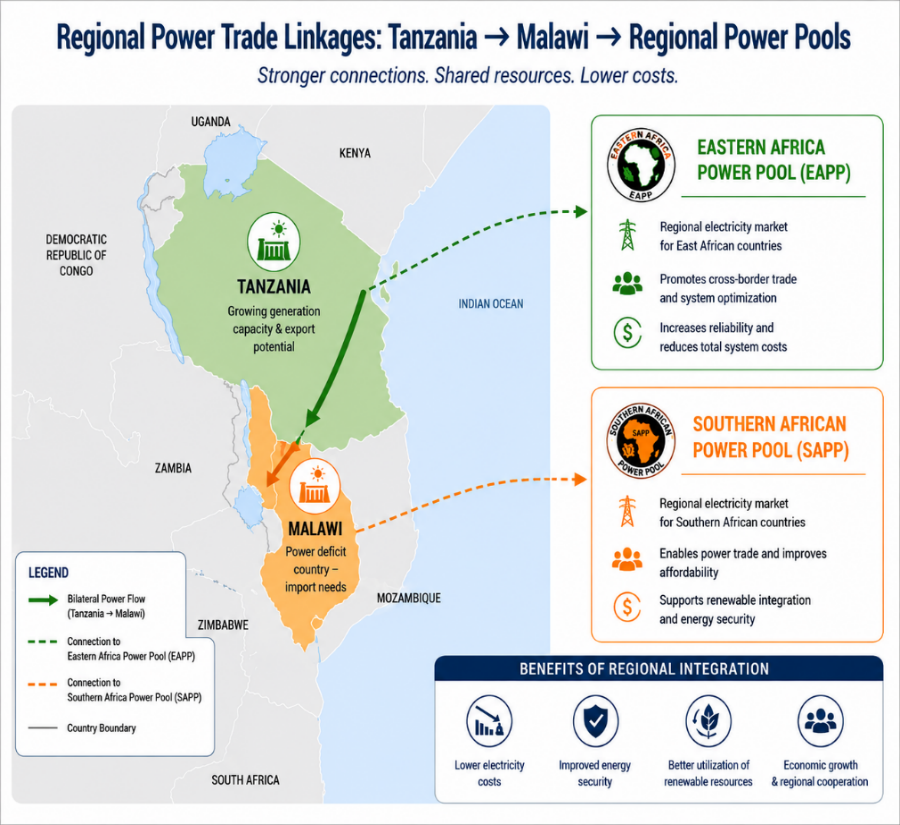
AI-Generated Illustrative diagram of the Tanzania-Malawi interconnection corridor (graphic for illustrative purposes only; not to scale)
The project is strategically important for Malawi, which has a history of power shortages and limited domestic generation capacity, while Tanzania has made significant investments in generation and transmission in recent years.
Malawi will benefit from access to cheaper imported electricity, reduced reliance on expensive thermal generation and enhanced energy security from the interconnector. For Tanzania, the project offers an opportunity to monetize surplus generation through regional electricity exports and to consolidate its position in regional electricity markets. Malawi will benefit from access to cheaper imported electricity, reduced reliance on expensive thermal generation, and enhanced energy security - initially importing 50 MW, with room to expand toward 200 MW as demand grows. For Mozambique, the project offers a further outlet to monetize surplus generation through regional electricity exports and consolidate its position as an emerging regional energy hub, alongside its planned Mozambique-Tanzania and Mozambique-Zambia interconnectors.
The Bank is also developing an innovative instrument to make this framework investable: the Africa Contract-for-Difference (Africa CfD). With the support of other development finance institutions such as British International Investment and the Sustainable Energy Fund for Africa, with SAPP as the envisaged settlement agent, the Africa CfD guarantees a minimum floor price on electricity sold by renewable IPPs into the SAPP merchant market. When six-monthly average prices fall below that floor, the guarantor pays the difference - securing the minimum revenue needed to service project debt without a fixed-price off-take agreement. The facility targets 1,500 MW of new renewable capacity and up to USD 100 million in committed capital. A pilot is currently underway targeting financial close for two greenfield IPPs in Q3 2026 - the first proof-of-concept for a price-risk hedge purpose-built for Africa's evolving competitive electricity markets.
The Africa Energy Portal, where this blog is published, is itself part of this integration infrastructure in a smaller way: an open-access platform aggregating energy data, policy analysis, and market intelligence across the continent, reducing the search costs and information asymmetry that otherwise slow investment decisions.
Looking ahead
Africa's cross-border power story is shifting from aspiration to architecture. Guaranteed intermediaries such as GreenCo - backed by risk capital facilities like GuarantCo's USD 27 million guarantee - show that sovereign payment risk can be translated into financeable market risk; transmission vehicles such as RTIFF, alongside near-complete physical links like MOMA, are turning corridors and bottleneck relief into dispatchable reality; and market reforms that expand the circle of credible buyers are transforming regional power pools from diplomatic constructs into investable marketplaces.
The stakes of getting this architecture right extend well beyond wholesale market efficiency, reaching to the core of Mission 300 - the continental commitment to connect 300 million Africans to electricity by 2030. That goal depends on the economics of power delivery shifting: countries that secure access to cheaper electricity through regional trade can extend grids to last-mile communities at substantially lower cost, maintain the utility revenue base that keeps distribution systems financially solvent, and sustain the political economy of continued investment. Guaranteed intermediaries, transmission finance facilities, policy reforms, regulatory harmonization, and market-risk tools such as the Africa CfD are the economic foundation without which Mission 300 cannot be realized.
Africa's energy future, should the continent sustain its investment in the institutional infrastructure that markets require - the risk absorbers, the transmission corridors, and the rules that govern exchange - will look less like a patchwork of isolated national grids starved of capital and more like an integrated, regional engine capable of powering the economic transformation that a rapidly urbanizing, demographically expanding population will demand.
Add New Comment