Under Construction

Webinar: 25 October 2018 | South Africa IRP2018 litmus test

The South African government’s draft IRP2018 (Integrated Resource Plan), constituting the country’s new electricity roadmap to 2030, has been released for public comment.

Previous updates of the 2010 version were not promulgated resulting in an outmoded plan being used to roll out energy and power infrastructure development; leaving new technologies and trends unable to easily be accommodated in the country’s energy mix.

Egypt: The Promise of Zohr

South Africa
Tags
Energy Access
Egypt: The Promise of Zohr

Despite the political turmoil that has rocked the country since the start of the century, Egypt’s economy has continued to grow at a solid pace: 5% a year before 2011, followed by a weaker, but never below 2%, increase after the fall of President Mubarak. Since General Sisi has come to power, growth has returned to around 4% a year, and the World Bank is forecasting that this figure will rise to up to 6% a year beginning in 2017. And that despite a sharp drop in tourism.

Egypt’s strong economic growth is barely sufficient to keep up with its surging population (80 million inhabitants in 2010, 95 million in 2017), a situation aggravated by a shortage of habitable land (7% habitable, 93% desert). As a result, nearly one-third of the Egyptian population still lives below the poverty line. Electricity consumption is rising sharply: up 70% from 2000 to 2010, followed by an average annual increase of 6.5% that is expected to continue until 20202.

With almost 80% of its electricity sourced from gas-fired power plants, Egypt, once an exporter of natural gas, had to import gas from Algeria, the Gulf and Russia, and even that wasn’t enough to fully meet domestic demand. Incessant power cuts, especially during the summer, have been a huge drag on industry and a source of ire among the population, prompting the president to make energy development a priority objective.

The Discovery of the Zohr Gas Field

After having studied various options, embarked on a nuclear power project with Russia’s Rosatom and unveiled a renewable energy program, the Egyptian government received excellent news in 2015: the Italian oil company Eni announced the discovery of a colossal natural gas field with an estimated 850 billion cubic meters of gas off the coast of Port Said, under 1,500 meters of water. The resources would be enough to satisfy domestic demand for several decades and allow Egypt to start exporting again and bring in foreign exchange revenues. The field was named Zohr.

Zohr’s discovery wasn’t surprising in this part of the eastern Mediterranean, where the existence of major fields has been known for a long time. Two large natural gas fields, Leviathan and Tamar, were discovered in Israeli waters at the end of the 1990s. Cyprus, for its part, claimed its rights to the Aphrodite gas field. Gaza too is entitled to develop its maritime zone.

Egypt has pressured Eni to step up the exploration and development of Zohr. Eni sold a 10% interest in the field to BP, which already has extensive operations in Egypt. Production at phase 1 is set to begin in October 2017. Eventually, the field is expected to produce 30 to 35 billion cubic meters of gas per year (Egypt’s current production is about 60 billion cubic meters).

If Zohr delivers on its promise, Egypt may decide to put the brakes on other projects, even if some of them are already quite advanced.

Date

Add New Comment

Feasibility of Photovoltaic Solar Power System for High School in Africa

South Africa
Tags
Energy Access
Feasibility of Photovoltaic Solar Power System for High School in Africa

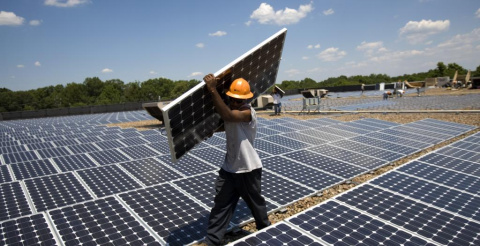
Sadisana High School is a private Jesuit school located in the rural town of Kikwit in the Democratic Republic of the Congo. The school comprises 18 classrooms, a school theater, 2 staff rooms, 2 meeting halls, and 2 laboratories. This school educates 600 boys and girls per year in sciences and is a pillar of the community in Kikwit. Every day between 4pm and 8pm, the school becomes a hub for the youth in community, it holds study time, tutoring sessions, extra-curricular and movies which require electricity.

In order to have electricity, the school relies on diesel generator which incurs high operating cost, is loud and emits GHG. It uses about 4,800 litres of fuel per year (1,268 US gal/yr). The school hired SMIN Power Group to conduct a feasibility study for a solar system that would be reliable, cost effective and efficient.

First, SMIN Power Group conducted a detailed audit and interviewed the customer to assess all the needs. The school daily energy need amounts to 42,000 Wh. Next, SMIN Power Group designed a stand alone solar photovoltaic system with energy storage and backup generator. The system consisted of a 9,000 Wp solar PV array, a battery bank with (28) 200Ah/12V deep cycle battery cells, charge-controllers with MPPT, (3) 3,000W inverters, and the control system. The backup generator would be used in case of need.

SMIN power Group also developed the cost estimate.  Long term, the system reduces energy costs by 30% for the school community. Our solution is a one-time investment and has a payback of 9,5 years.

Our solution provides clean, reliable, cost effective and quiet electricity for the customer. SMIN Power Group is helping the community fight climate change to preserve the Earth for future generations. SMIN Power Group designed a system that will avoid 269 Metric Tons of greenhouse gas emissions over 25 years. According to the USA Environmental Protection Agency, this is equivalent to removing 56.9 cars off the road for a year. It is also equivalent to avoid the CO2 emissions from 30,307 gallons of gasoline.

Date

Comments

Add New Comment

Renewable energy in Africa

South Africa
Tags
Energy Access
Renewable energy in Africa

The Library, Documentation and Information Department of the African Studies Centre has compiled this dossier to coincide with the NVAS AFRICA DAY 2015 – AFRICA and TECHNOLOGY on October 17, 2015. It contains a selection of recent titles on Renewable Energy in Africa from the library's online catalogue, including monographs, articles, and chapters from edited works, published since 2013. Each title links directly to the corresponding record in the online catalogue, which provides a more detailed description of every title as well as abstracts of  articles and edited works. The dossier starts with an introduction to the topic, followed by sections on Renewable Energy Resources, Planning & Policies, and Local Impact stories illustrating how applied renewable energy technology can change lives as in the case of improved fuel efficient cook stoves and photovoltaics. The dossier concludes with a selection of links to relevant websites.

The interest among academics, policymakers and the general public in issues of renewable energy in Africa has surged in recent years. Technological advances, political and economic pressures, as well as environmental imperatives, have driven rapid growth in renewable energy production and supply. Important international agreements, such as the Kyoto Protocol and efforts to implement carbon credits, support the search for more renewable energy sources. On the African continent there has been a specific interest in hydroelectricity, as well as wind energy, solar energy, biofuels (such as jatropha oil), and fuel efficient cook stoves. Renewable energy debates have been linked to topics of sustainability and energy policy, but less frequently to existing discussions about natural resource management. In the policy arena, most African governments participate in discussions about renewable energy, and NGOs, such as AFREPREN (African Energy Policy Research Network), play an important role in lobbying and research. Research into renewable energy is conducted at prominent institutions, such as at the Department of Geography, Environmental Management and Energy Studies, the University of Johannesburg.

Despite growing interest in the broader theme of renewable energy, the academic debate continues to suffer from several weaknesses. The first is the gap between policymakers, practitioners and academics. Whereas there are numerous reports and extensive ‘grey literature’ on issues of renewable energy in Africa, there is a limited number of academic peer-reviewed work. Moreover, academics and practitioners are unwilling to share their results with each other. The second weakness is the distance between technical and social science approaches towards renewable energy. The vast majority of academic articles on issues of renewable energy come from the technical or exact sciences, for example, measuring the combustion efficiency or health impacts of improved cook stoves. The social sciences angle is often missing. In the debate on adopting improved cook stoves, this results in accusations of creating ‘cultural barriers’, whereas a social scientist can put such generic categories into context and emphasize specific cooking habits or natural resource management in different localities. Ethnographic and consumer research, questioning why renewable energy sources do or do not work, would be a valuable and a timely addition to the existing debate. Furthermore, a regional or comparative focus could be adopted more systematically. Whereas at present, case studies of renewable energy exist for various localities (West Africa, East Africa, Southern Africa), it is important that these case studies should be linked together,  so that comparing their similarities or differences is more straightforward and thus a more effective continent-wide policy framework can be drafted.

Date

Add New Comment

Energy Sector Development in Sub Saharan Africa: Case Study of Rwanda

South Africa
Tags
Energy Access
Energy Sector Development in Sub Saharan Africa: Case Study of Rwanda

Developing countries continue to surge their primary, secondary and tertiary sectors of development. Energy demand continues to grow rapidly and effort is being made to efficiently extract and discover new energy sources. These processes consist of extraction, processing and conversion into useful energy such as heat, gas and electricity . The strong need of electricity is observed in every development sector which shows total dependency on electricity particularly in hospitals, industries, factories, commercial areas, public institutions and households. Developing countries’ energy sector is characterized by two main factors; the use of traditional and cheap energy source such as fuel wood-biomass and charcoal which lead people to stick to it. The second is the high demand and undistributed use of modern energy sources like electricity, gas and petroleum which prevent its widespread in rural areas . According to the United Nation projection; population (7.3 billion-2015) will continue to grow with 1.18% per year which means almost addition of 83 million people annually who will need enough electricity in their everyday life . Since the beginning of 21st century, Sub Saharan Africa is having a very significant economic growth reaching more than double $ 2.7 trillion in year 2013. Energy demand within this region grew by 45% from 2000 to 2015 and account 4% on global demand. Limited number in sub Saharan Africans have access to modern energy services and more than 620 million people (two-thirds of world population) are without access to electricity . Nowadays, sub Saharan Africa has about 800 million people distributed in 38 countries. The projected population in 2050 will count 685 million (age 0-14), 1.25 billion (age 15-64) and 100 million (older than 65). The economic growth is driven by investment in mining, oil and infrastructure. The slowdown may be caused by lower global oil adjustment, insecurity and political instability. Sub- Sahara African countries have been linked to be low income countries with a huge number of population living in poverty. The region stays in average of 248 kg of oil equivalent to 238 kg which is almost half of world average. The electricity is unequally distributed with more connected households in urban areas than in rural areas. As Sub-Sahara Africa continues to initiate and invest in energy development, this research paper is expected to assess today’s African energy infrastructure development and its installed capacity and later focus on Rwanda’s energy sector development.

Date

Add New Comment

GE Power announces plans for energy distribution across Africa in new white paper

The grid solution business of the US-based energy firm, GE Power, has released a white paper revealing plans for energy transmission and distribution across sub Saharan Africa.

The paper, titled ‘Digitization of Energy Transmission & Distribution in Africa’, addresses both opportunities and challenges facing the energy industry in the region.

The company has evaluated smart technology and its ability to transform grids, with smart grids offering efficient, reliable, and affordable power, as well as providing energy security.