
Potential, Policies, Financing, and de-risking in renewable energy sector in Africa
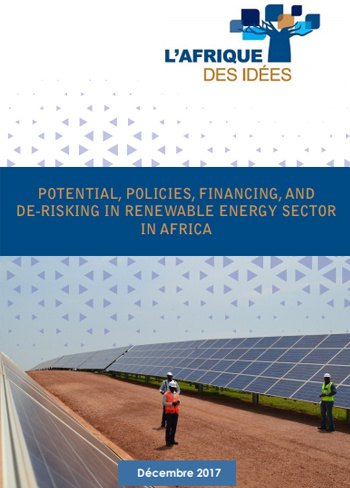
600 million Africans have no access to electricity while the energy sources, especially renew-able energies (RE) abound on the continent. Its key features: environment friendly, availability and its recent cost competitiveness gains over fossil energy; make renewable energy an ex-cellent avenue to start an energy revolution in African. However, having affordable, sustain-able and smooth access to energy has a cost. Public policy in investments promotion and risk mitigation in the RE sector are among other issues on which African Government should work on.
After re-evaluating the potential of the continent in terms of renewable energy sources, and the energy needs in various sectors, we note the significant gap between the installed capacities and forecasted energy mix needs. We assess the investment needs in light of the renewable energy targets of African countries. Strong competition for capital exists in the sector, between developed and developing countries, and also within developing countries. We point out how countries are performing with regard to putting in place incentives for investors, while contrasting national and regional performance disparities. After the near future projections of the continent’s labor force, human capital formation, maintenance and quality in the scenario where investments and subsequent policies are in place, we suggest avenues of actions in attracting and substantiating investments, de-risking the sector, and taking advantage of the potential of the continent.
We find that, in terms of installed energy capacity and policies, countries perform very differently with, for instance, Morocco and South Africa leading the way, to attract most of the foreign and domestic investments. At the regional level, Northern and Eastern Africa show strong commitment by laying out ambitious incentives tools and fiscal policies. West Africa has strong regional platforms, with aspirations that are yet to be operational. Regarding small-scale projects, most countries have several ongoing projects, at least to address the energy needs of local communities. However, Morocco is the only country that has a Concentrated Solar Plant (CSP), while a few other countries are host to several large-scale projects. Most African countries are lagging behind in terms of labor force anticipation and human capital training for maintenance, implying the need for better forecasting of critical areas that will affect the sustainable, renewable energy sector in the long run. In the light of those findings, we recommend that:
- African countries explore alternative financing tools, or better still, develop very strong and pro-active Public-Private Partnerships for investments in the sector.
- African countries accelerate reforms and lay out working and ambitious fiscal policies that signal their commitment to attract investments.
- African countries work on operative regional platforms, especially around large-scale projects, and anticipate the labor force and human capital development to gear up for the near future needs of the sustainable renewable energy sector.